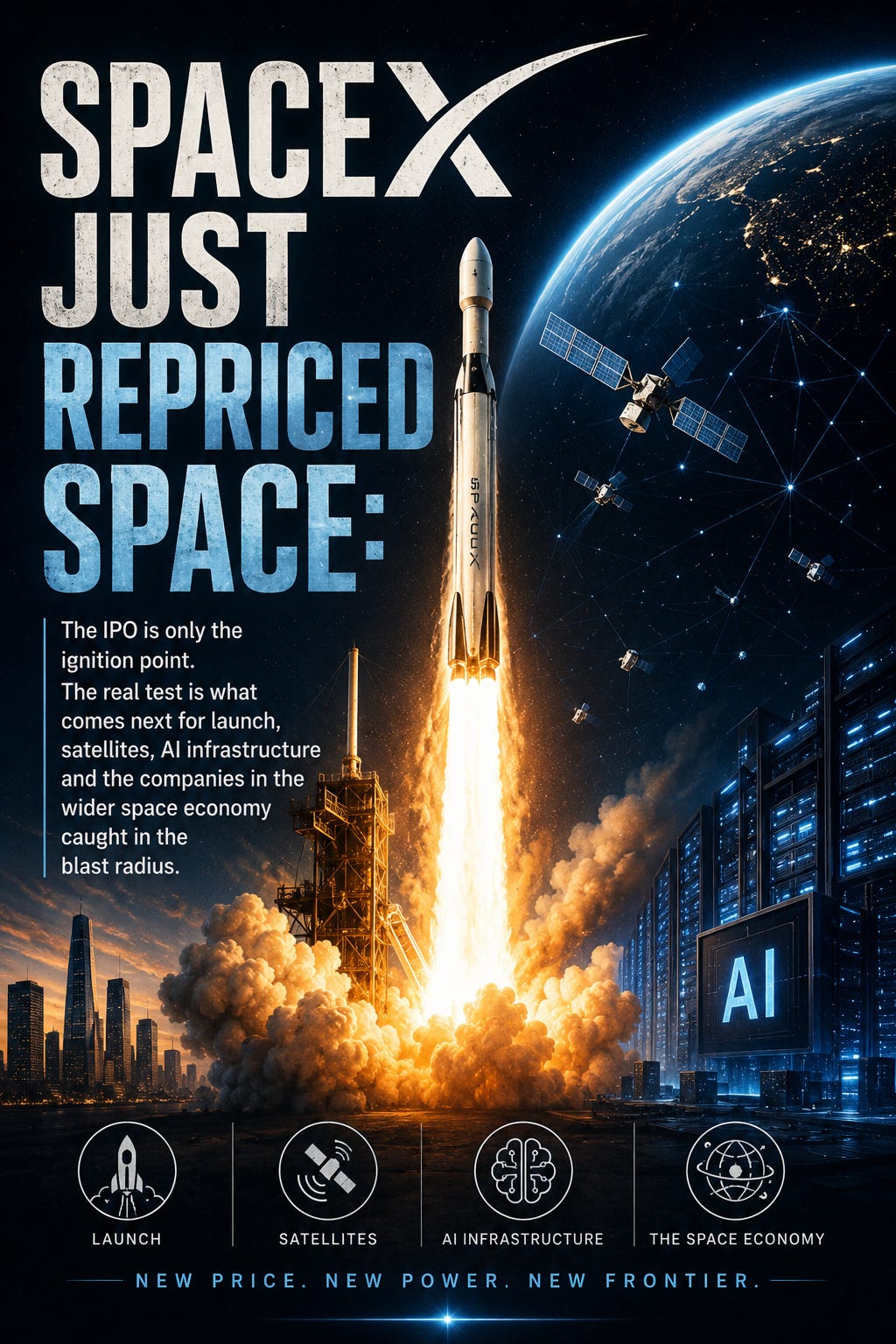
SpaceX Just Repriced Space
The IPO is only the ignition point. The real test is what comes next for launch, satellites, AI infrastructure and the companies in the wider space economy caught in the blast radius.

SpaceX’s IPO was easy to describe as a record-breaking market event. That is true, but incomplete.
The more important point is that public markets have now been asked to price space not as a distant frontier, and not as a narrow aerospace niche, but as infrastructure: launch capacity, satellite broadband, defence connectivity, lunar architecture, AI compute exposure and long-term orbital logistics inside one company.
That is a very different proposition from “a rocket company going public”.
It also creates a difficult question for the rest of the sector. If SpaceX is now the benchmark, what exactly is everyone else being measured against?
SpaceX’s initial public offering is not only a financing event. It is a market signal about how public investors are beginning to classify space infrastructure.
The basic transaction is straightforward. SpaceX sold shares to public investors, moving from a privately held company into the listed equity market. In practical terms, this means a much wider investor base can now buy and sell exposure to the company. It also means the company is subject to the disciplines and expectations of public markets: disclosure, analyst coverage, index inclusion, quarterly scrutiny, governance assessment and continuous valuation.
The significance lies less in the mechanics of the IPO and more in what the market is being asked to price.
SpaceX is not a conventional aerospace supplier. It combines launch services, satellite broadband, government contracting, defence-related infrastructure, lunar architecture, vertically integrated manufacturing, artificial intelligence exposure, and a still-developing heavy-lift system in Starship. The IPO therefore does not simply value an existing rocket business. It attempts to value a platform whose future economics depend on falling launch costs, expanding satellite services, government demand, AI infrastructure, and the possible industrialisation of orbital logistics.
That makes the listing a useful case study for the wider space economy. It shows how public capital may value space when the sector is presented not as exploration, but as infrastructure.
1. What happened in the IPO?
Reuters reported that SpaceX priced its IPO at $135 per share, selling approximately 555.56 million shares and raising $75 billion. The transaction valued the company at around $1.77 trillion at the time of pricing, making it the largest IPO on record. After underwriters exercised the greenshoe option, total proceeds reportedly rose to $85.7 billion. [1][2]
For readers outside finance, two terms matter here.
The first is primary issuance. When an IPO is primary, the company itself sells new shares and receives the proceeds. This is different from existing shareholders selling their own shares. A primary IPO strengthens the company’s balance sheet because the cash goes into the business. In SpaceX’s case, this matters because launch systems, satellite networks, manufacturing scale, AI infrastructure and ground networks are capital-intensive.
The second is the greenshoe option. This is an over-allotment mechanism that allows underwriters to sell additional shares if demand is strong. It is often used to stabilise trading after an IPO. In this case, the full exercise of the greenshoe increased the amount of capital raised and confirmed the depth of investor demand. [2]
The demand signal was also important. Reuters reported before pricing that the order book was approaching four times the planned offering size, with more than $250 billion of investor demand against the $75 billion SpaceX was seeking to raise. [3] That matters because the IPO was not only large. It was absorbed by a deep institutional investor base.
The first trading sessions then provided an early indication of market appetite. Reuters reported that SpaceX shares rose materially on their Nasdaq debut, pushing the company’s market value above $2 trillion. [4] That does not prove the valuation is sustainable, but it does show that initial demand extended beyond the IPO allocation itself.
The result is a company with unusually large public-market capacity. It has raised a very large amount of cash, created a liquid public equity instrument, and given investors a benchmark through which to price the space sector more broadly.
2. Why the valuation is not only about rockets
A valuation is not an award for past performance. It is a forward-looking claim on future cash flows, growth expectations and strategic optionality.
In SpaceX’s case, the valuation appears to rest on five overlapping business layers.
The first layer is launch. Falcon 9 has already altered the economics of access to orbit by demonstrating repeatable booster reuse and high launch cadence. SpaceX’s own launch records show the scale and frequency of Falcon and Starlink-related missions, while FAA documentation reflects the regulatory attention required to support higher launch cadence at key sites. [5][6]
The second layer is Starlink. Launch is episodic: a customer pays for a mission. Satellite communications can be recurring: users pay for connectivity over time. This changes the character of the business. It brings SpaceX closer to telecoms and infrastructure economics, where networks require heavy upfront investment but can produce repeated revenues over a long operating life.
This distinction matters financially. IPO-related reporting indicated that Starlink was SpaceX’s largest revenue driver and the strongest segment within the company’s financial profile before listing. [7][8] That makes Starlink central to the valuation case. Launch provides strategic control. Starship provides long-term optionality. But the recurring-connectivity business appears to be doing much of the current financial work.
The third layer is government and national-security demand. Space is not a purely commercial market. NASA programmes, defence requirements, communications resilience and sovereign access to space all shape demand. NASA’s Human Landing System programme, for example, places commercial providers at the centre of future lunar landing architectures. [9] That creates opportunity, but also means SpaceX’s market position is partly tied to public-sector priorities, procurement cycles and strategic policy.
The fourth layer is Starship optionality. Starship is not yet a routine operational transport system, but it is central to the long-term thesis. If fully and rapidly reusable heavy-lift launch becomes operationally mature, the marginal economics of moving mass to orbit could change substantially. This would not make space “cheap” in an absolute sense. Payloads, testing, insurance, spectrum, ground infrastructure and operations would still be expensive. But launch could become a smaller share of total mission cost for many applications.
The fifth layer is AI and data infrastructure. This has become harder to separate from the SpaceX story. The company’s acquisition of xAI before the IPO, followed by the post-IPO agreement to acquire Anysphere, the company behind Cursor, shows that SpaceX is being positioned not only as a space and connectivity platform, but as a broader technology infrastructure company. [10][11]
That is the core valuation question. Investors are not only pricing what SpaceX currently does. They are pricing the possibility that SpaceX changes the cost structure of space activity while also expanding into adjacent infrastructure markets such as AI, data centres, software tools and compute-heavy services.
3. What the IPO says about valuation
The IPO also provides a financial signal.
At the IPO price of $135 per share, SpaceX sold approximately 555.56 million shares and raised about $75 billion. The transaction valued the company at approximately $1.77 trillion. After underwriters exercised the greenshoe option, total IPO proceeds reportedly increased to $85.7 billion. The first trading sessions then pushed the company’s market value above $2 trillion. [1][2][4]
Those figures matter because they place SpaceX in a different category from previous space listings. This was not a small growth-company IPO. It was a mega-cap public listing at the scale of the world’s largest technology, energy and infrastructure companies.
The valuation is especially striking when compared with reported financial performance. SpaceX generated approximately $18.7 billion of revenue in 2025. Reported figures also show an annual operating loss of about $2.6 billion, adjusted EBITDA of approximately $6.6 billion, and a wider net loss when the combined SpaceX/xAI structure is considered. [7][8][12]
This is the core financial tension.
The company is already large by private-market standards, but the IPO valuation is not based on current earnings alone. A business valued at more than 100 times trailing revenue needs the market to believe in a much larger future revenue base, higher future margins, and productive reinvestment of capital. In other words, the valuation is not only a judgement on what SpaceX is today. It is a judgement on what investors think the company may become.
The comparison with previous large IPOs is useful. Saudi Aramco’s listing was supported by enormous existing profitability. Alibaba and Facebook entered public markets with dominant consumer-internet platforms and clearer operating leverage. Arm’s IPO was much smaller in absolute terms and rested on semiconductor intellectual property economics. SpaceX is different. It is being valued as an integrated infrastructure platform, not as a conventional aerospace, telecoms, defence or software company.
The segment structure helps explain the premium. Launch provides the access layer. Starlink provides recurring network revenue. Government and defence activity provide strategic demand. Starship adds long-term optionality around the cost and cadence of moving mass to orbit. AI adds a second capital-intensive growth vector. The market is therefore not valuing one revenue stream in isolation. It is valuing the possibility that these layers reinforce each other over time.
However, that also increases valuation risk.
A high revenue multiple can only be justified if growth remains strong, margins improve, capital expenditure produces durable returns, and technical progress converts into cash flow. That is demanding for any company. It is especially demanding for a business exposed to launch reliability, regulatory approvals, satellite replacement cycles, spectrum constraints, public-sector procurement, large engineering programmes, AI compute spending and data-centre infrastructure.
Independent valuation work has already highlighted this tension. Aswath Damodaran’s post-prospectus analysis estimated SpaceX’s equity value below the IPO valuation, illustrating that the disagreement is not about whether SpaceX is strategically important. It is about how much future success should be capitalised today. [13]
This distinction matters for the wider space sector.
The SpaceX IPO may make space more visible to public capital, but it does not mean every space company deserves a SpaceX-style multiple. The market is rewarding a particular combination: scale, vertical integration, recurring revenue, strategic relevance, public-market liquidity and long-term optionality. Companies without those characteristics may face a more difficult comparison, not an easier one.
4. The post-IPO capital sequence: Cursor, the share drop and the bond signal
The first week after the IPO is important because it showed how SpaceX may use its new public-market status.
On 16 June, Reuters reported that SpaceX agreed to acquire Anysphere, the startup behind the AI coding agent Cursor, for $60 billion in an all-stock transaction. The deal followed the company’s Nasdaq debut and was framed as a move to strengthen SpaceX’s position in enterprise AI tools and coding agents. Reuters also reported that the transaction would not use IPO proceeds and was expected to close in the third quarter of 2026. [11]
The structure of the deal matters. Because the acquisition is all stock, SpaceX is using its high market valuation as acquisition currency. That is one of the main strategic advantages of a successful IPO. A richly valued public company can buy assets without immediately using cash, and with less dilution than would be required at a lower valuation.
The Cursor deal also did not emerge in isolation. Reuters had reported before the acquisition that Cursor had been courted by SpaceX and that SpaceX held an option to buy it for $60 billion. [14] This makes the transaction look less like an impulsive post-listing acquisition and more like part of a pre-existing AI infrastructure strategy.
But the timing still changed the market’s interpretation of the IPO.
Only days after raising $75 billion, and after the greenshoe lifted proceeds to $85.7 billion, SpaceX had already announced a $60 billion acquisition and was being linked to a further debt raise. On 18 June, Reuters reported that SpaceX’s bankers were preparing to meet investors as early as the following week to discuss a bond offering of at least $20 billion. The reported purpose was to refinance a $20 billion bridge loan taken earlier in the year after SpaceX acquired xAI, with the debt also linked to the company’s capital-intensive AI expansion. [15]
That sequence is analytically significant.
It does not mean SpaceX is financially weak. The opposite may be true: only a company with strong market access can raise equity, use stock for a mega-acquisition, and prepare a major bond sale within days of listing. But it does show how cash-hungry the model has become. SpaceX is no longer only funding rockets and satellites. It is funding launch systems, Starlink, Starship, manufacturing capacity, ground infrastructure, AI models, computing hardware, data centres and power infrastructure.
The market reaction reflected that tension. Reuters reported that SpaceX shares fell more than 6% on 18 June as the post-IPO frenzy lost momentum, though the stock remained above its $135 offering price. [16] Business Insider separately reported that the stock had slipped after an initial rally, with investors reassessing the pace and scale of capital deployment following the Cursor acquisition. [17]
The broader market context also matters. The Wall Street Journal described the SpaceX-Cursor transaction as part of a wider wave of AI-related stock issuance, warning that heavy equity-financed AI dealmaking can be a sign of elevated valuations as well as investor appetite. [18] This does not invalidate the strategic rationale for the deal, but it does place it in a broader capital-market pattern: when equity is expensive, companies have an incentive to use it.
This is not a contradiction. It is what public markets do.
The IPO gave SpaceX a much larger financial toolkit. The Cursor transaction showed how quickly that toolkit can be used. The potential bond offering showed that equity proceeds alone may not be sufficient for the combined ambition. The share-price pullback showed that public investors may support the long-term story while still questioning the near-term funding intensity.
For the space sector, this is one of the most important lessons of the IPO. The future of space infrastructure may be more investable than before, but it is not becoming capital-light. If anything, the SpaceX case suggests that the next phase of the sector may require larger balance sheets, more complex financing structures and a greater tolerance for long-duration capital deployment.
5. What the IPO changes for SpaceX
The IPO gives SpaceX three important advantages.
First, it provides capital scale. Public markets can supply funding at a level that few private markets can sustain indefinitely. That matters for satellite replacement cycles, launch infrastructure, Starship development, manufacturing capacity, user terminals, ground networks, AI infrastructure and power-intensive computing.
Second, it creates strategic currency. Listed shares can be used for acquisitions, employee compensation and balance-sheet flexibility. The Cursor deal is an early example of this mechanism. A high equity valuation does not only reward existing shareholders. It can become a tool for expansion. [11][17]
Third, it increases institutional visibility. Once public, SpaceX becomes easier for pension funds, mutual funds, index products and retail investors to own. That changes the company’s investor base from a relatively restricted private-market group to a broader public-market audience.
However, the same process also increases constraints.
Public investors tend to demand regular evidence of progress. This can be uncomfortable for complex engineering businesses. Rocket development does not follow quarterly reporting cycles. Test failures, launch delays, regulatory reviews and certification issues are normal features of aerospace development, but public markets often react sharply when expectations move faster than technical reality.
The listing therefore increases both financial capacity and financial pressure.
6. The first domino effect: public markets now have a space benchmark
The most immediate effect is that SpaceX becomes the reference point for listed space exposure.
Before the IPO, investors who wanted public-market space exposure had to use a mix of satellite operators, launch start-ups, defence contractors, Earth observation companies, special-purpose acquisition company remnants, suppliers and thematic exchange-traded funds. None of these provided a clean proxy for the integrated space economy.
SpaceX changes that.
Its listing gives investors a single, highly visible benchmark across launch, satellites, connectivity, defence-related infrastructure, AI and long-term exploration optionality. That can raise the profile of the whole sector. It can also make comparisons harsher.
Companies with real revenue, strong contracts, defensible technology and credible execution may benefit from renewed attention. Companies that rely mainly on narrative may face more scepticism. Investopedia reported that other space-linked equities initially came under pressure after SpaceX’s debut, suggesting that investors may have rotated toward the dominant platform and away from weaker or less proven names. [19]
There is also evidence of the opposite effect: other space companies may now try to use the SpaceX listing as a valuation reference. Reuters reported that German satellite maker OHB launched a share sale with KKR, aiming to raise up to €510.7 million through new shares while increasing its free float. The transaction was explicitly framed against increased investor interest in space stocks following SpaceX’s IPO. [20]
This is the double-edged nature of the benchmark effect. SpaceX can raise investor attention across the sector, but it can also increase the burden of proof for everyone else.
7. The second domino effect: launch economics become harder to defend
SpaceX has already placed structural pressure on launch pricing through Falcon 9 reuse and rideshare services. If Starship becomes operational, that pressure could intensify.
The effects would not be evenly distributed.
For satellite operators and payload customers, lower launch costs and higher cadence are positive. They reduce one of the major barriers to mission deployment. They also support larger constellations, faster replenishment, more frequent technology refresh cycles and more experimental payload architectures.
For small launch providers, the picture is more difficult. Dedicated launch still has a role. Some customers need specific orbital insertion, schedule control, sovereign launch access, military responsiveness or payload isolation. But the broad commercial market for small satellites becomes harder if a dominant rideshare provider can offer frequent and relatively low-cost access to orbit.
This does not mean small launch disappears. It means the business model narrows. The winners are more likely to be specialised, responsive, government-backed, or technically differentiated. The companies positioned only as generic alternatives to rideshare face a more difficult path.
In industrial terms, this is not unusual. When a dominant provider reduces the cost of a bottleneck, the rest of the value chain reorganises around the new constraint. The bottleneck may move from launch to payload production, mission assurance, spectrum allocation, data processing, ground infrastructure, customer acquisition or orbital traffic management.
8. The third domino effect: satellite communications becomes a scale market
Starlink is important because it changes what satellite communications means to non-specialist customers.
Historically, satellite connectivity was often associated with specialised, high-cost use cases: maritime, aviation, remote industrial sites, disaster recovery, military operations and underserved regions. Low Earth orbit broadband changes the user expectation. Customers increasingly compare space-based connectivity not with legacy satellite services, but with terrestrial broadband and mobile networks.
That expectation shift matters.
It places pressure on geostationary satellite broadband models, legacy pricing structures and slower deployment cycles. It also creates new opportunities in aviation, maritime, rural connectivity, emergency response, defence communications and direct-to-device services.
The risk is concentration. SpaceX is vertically integrated: it builds satellites, launches them, operates the network and sells the service. This can produce cost and execution advantages. It can also create strategic dependency for customers and discomfort for competitors that may depend on SpaceX launch services while competing against Starlink in communications markets.
The policy issue is not whether vertical integration is good or bad in the abstract. The issue is resilience. A highly efficient system can still be fragile if too much capacity, pricing power or operational control concentrates in one provider.
9. The fourth domino effect: government procurement accelerates, but dependency rises
SpaceX’s public-market capital base may strengthen its ability to deliver large government and strategic programmes. NASA’s Artemis architecture is one example. The Human Landing System programme relies on commercial providers for lunar landing capability, and SpaceX’s Starship architecture is part of that programme. [9][21]
This is a major change from the older model in which governments directly controlled much more of the technical architecture. Commercial providers can move quickly, absorb development risk and apply private-sector manufacturing discipline. That can reduce costs and accelerate capability.
The downside is dependency.
When a government relies heavily on a dominant commercial provider for launch, communications or lunar infrastructure, it gains capability but may lose negotiating flexibility. This becomes especially relevant in defence and national-security contexts, where redundancy and sovereign control matter.
A balanced procurement strategy therefore has to separate efficiency from resilience. The lowest-cost or fastest provider may be the best answer for many missions. It may not be the best answer for every strategic requirement.
10. The fifth domino effect: space becomes a mainstream investment category
The IPO also has cultural and financial effects outside the technical space community.
A record public listing makes space visible to generalist investors. It puts space infrastructure into the same conversation as artificial intelligence, semiconductors, defence technology, cloud infrastructure and energy systems. Reuters has already linked SpaceX’s listing to a broader mega-IPO environment and renewed interest in public listings and SPACs. [22]
This mainstreaming has advantages.
It can attract capital, talent and policy attention. It can encourage universities, founders and suppliers to treat space as a serious industrial domain rather than a niche research activity. It may also improve liquidity across the sector by bringing more analysts and institutional investors into the market.
But mainstreaming also carries risks.
Public markets can compress complex technical realities into simple narratives. “Space is now investable” is not a sufficient thesis. Individual businesses still have to prove unit economics, mission reliability, regulatory access, customer demand and competitive defensibility. More attention can therefore improve the sector, but it can also recreate the conditions for speculative excess.
The SPAC cycle of the early 2020s is the relevant warning. Many space companies entered public markets with long-range projections and limited operating history. Several then struggled as timelines slipped and revenue forecasts failed to materialise. A SpaceX IPO may reopen investor interest, but it should also raise the standard of evidence.
11. What opportunities does the IPO create?
The opportunity set is broad, but it is not evenly distributed.
The first opportunity is mission expansion. Lower launch costs and higher cadence make more missions economically plausible. Earth observation, communications, climate monitoring, disaster response, in-orbit servicing, national-security sensing and lunar logistics all benefit if access to orbit becomes more frequent and predictable.
The second opportunity is industrial volume. Higher launch cadence and larger constellations create demand for components, avionics, propulsion systems, antennas, solar arrays, sensors, thermal systems, ground stations and software. Suppliers that can meet aerospace quality requirements at higher production rates may benefit.
The third opportunity is data infrastructure. More satellites mean more data. The economic value may increasingly sit not only in the spacecraft, but in the processing, interpretation and distribution of the data they generate. This is particularly relevant for Earth observation, defence intelligence, weather monitoring, maritime tracking and climate analytics.
The fourth opportunity is strategic resilience. Proliferated satellite architectures can be more resilient than a small number of exquisite assets. This is one reason governments are interested in distributed space systems. More nodes can mean greater redundancy, faster replenishment and less single-point vulnerability.
The fifth opportunity is public understanding. SpaceX has made launch visible to a much broader audience. That matters for talent pipelines. A sector that is visible attracts engineers, software developers, finance professionals, policy specialists and entrepreneurs.
The sixth opportunity is capital formation. The OHB transaction is a useful early signal. If SpaceX increases investor appetite for space infrastructure, other companies may be able to raise capital, increase free float, improve liquidity and access public markets on better terms. [20] But that opportunity will not be evenly distributed. Public capital will still differentiate between credible infrastructure businesses and weaker narratives.
12. What could the IPO destroy or weaken?
The destructive effects are equally important.
First, it may weaken undifferentiated launch providers. Companies whose main argument is simply that launch demand is growing may struggle if they cannot offer a clear advantage in orbit, responsiveness, national access, price, reliability or payload class.
Second, it may compress legacy satellite pricing. If Starlink and other LEO systems reset customer expectations around latency, installation and price, older models may lose pricing power. This does not eliminate all geostationary satellites, which still have important roles, but it does pressure weaker broadband offerings.
Third, it may reduce capital diversity. If investors view SpaceX as the safest or most complete way to own the space theme, smaller companies may find it harder to raise money, even when they provide valuable specialised capabilities.
Fourth, it may increase systemic dependency. If launch, broadband, defence connectivity, AI infrastructure and lunar logistics increasingly route through one provider, the sector may become efficient but less diversified.
Fifth, it may intensify orbital sustainability pressures. More launches and larger constellations increase the importance of debris mitigation, collision avoidance, atmospheric re-entry impacts, spectrum management and orbital governance. Recent academic work on LEO constellation life-cycle emissions highlights that launch vehicle production, propellant combustion and satellite deployment choices can materially affect environmental outcomes. [23] Reusability may reduce some production-related impacts, but the overall scale of constellation growth still requires careful assessment.
Finally, the IPO may create valuation risk. A high valuation gives SpaceX strategic power, but it also embeds very high expectations. If Starship development takes longer than expected, if Starlink growth slows, if regulatory constraints increase, if AI spending does not convert into durable revenue, or if public investors rotate away from high-growth infrastructure stories, the stock could become volatile. A large market capitalisation does not remove engineering risk. It monetises expectations before the engineering programme is complete.
13. Governance, disclosure and cost of capital will become part of the story
As a private company, SpaceX could operate with limited public disclosure. As a listed company, it becomes part of the public-market governance ecosystem.
That matters because public investors need to assess not only revenue growth and technical progress, but also risk controls, board structure, shareholder rights, related-party issues, safety culture, environmental exposure, litigation risk and regulatory compliance.
The Financial Times reported that MSCI assigned SpaceX its lowest ESG rating ahead of the IPO, citing governance and risk-management concerns. [24] ESG ratings are not a complete measure of company quality, and they often involve contested methodologies. But the existence of such scrutiny matters. Public markets price governance differently from private markets, especially when index funds, institutional mandates and international investors are involved.
The potential bond offering adds another dimension. Equity investors are buying upside. Bond investors focus more heavily on repayment capacity, cash generation, leverage and downside protection. If SpaceX enters the investment-grade bond market at large scale, its disclosure, cash-flow profile and capital allocation strategy will matter not only for shareholders, but for creditors. [15]
That may discipline the company, but it may also expose a structural tension. SpaceX’s business model is increasingly built around large capital programmes: reusable launch, satellite networks, Starship, AI infrastructure, data centres and power systems. The more the company expands across those domains, the more important its cost of capital becomes.
14. The balanced interpretation
The SpaceX IPO does not prove that the space economy has fully matured. It proves that public markets are willing to capitalise one company as if space infrastructure can become a major economic category.
That is an important distinction.
The IPO creates financial capacity, but it does not eliminate technical risk. It validates investor appetite, but it does not validate every space business model. It may reduce launch-cost constraints, but it does not remove constraints in manufacturing, regulation, insurance, spectrum, debris management, power infrastructure, data-centre economics or customer demand.
The post-IPO sequence makes that clearer, not less clear.
The Cursor acquisition shows that SpaceX can now use its valuation as strategic currency. The reported bond preparation shows that even after a record IPO, the company may still require very large debt financing to support its broader ambitions. The share-price pullback shows that public investors may admire the long-term thesis while questioning the pace of capital deployment.
The most likely outcome is not that SpaceX “lifts all boats” equally. A more realistic outcome is sorting.
Some companies will benefit because SpaceX expands the addressable market and reduces infrastructure costs. Some will be weakened because their business models depended on scarcity, high launch prices or limited competition. Some will become acquisition targets. Some will become strategic suppliers. Some will disappear.
That is what maturing industries do.
The central question after the IPO is therefore not whether space is now investable. It is which parts of space can become durable infrastructure, which remain strategic public goods, which can support public-market valuations, and which were only investable when capital was cheap and narratives were loose.
The SpaceX IPO does not answer every question about the future of space.
It makes those questions bigger, more urgent and more investable.
That is the real shift: space is no longer being priced as a distant frontier. It is being tested as the next layer of infrastructure.
The sector has entered a new phase: less theatre, more proof. The companies that matter now will not be the ones with the biggest promises, but the ones that can convert ambition into cadence, cost discipline and infrastructure that survives contact with reality.
References:
[1] Reuters — IPO pricing and initial proceeds. Used for the $135/share price, 555.56 million shares sold, $75 billion raised and approximate $1.77 trillion valuation.
[2] Reuters — Greenshoe and final proceeds. Used for the increase in IPO proceeds to $85.7 billion after underwriters exercised the greenshoe option, and for the post-IPO rally context.
[3] Reuters — IPO oversubscription. Used for the report that SpaceX drew more than $250 billion of investor demand, approaching four times the planned offering size.
[4] Reuters — Nasdaq debut and market value. Used for the post-IPO share-price increase and market capitalisation moving above $2 trillion.
[5] SpaceX — launch records and mission activity. Used for company-side context on Falcon, Starlink and launch cadence.
[6] FAA — Falcon 9/Falcon Heavy cadence and launch-site regulatory context. Used for regulatory context around increasing launch cadence at Vandenberg, including the increase from 50 to 100 annual Falcon 9/Falcon Heavy launches across SLC-4 and SLC-6.
[7] Payload Space — SpaceX financial data ahead of IPO. Used for reported 2025 revenue of approximately $18.7 billion, operating loss of about $2.6 billion and adjusted EBITDA of about $6.6 billion.
[8] Satellite Today — SpaceX S-1 financial context. Used for the reported 2025 revenue, net loss, operating loss, adjusted EBITDA and Starlink revenue role from the IPO filing.
[9] NASA — Human Landing System / Artemis. Used for Artemis/lunar architecture context and the role of commercial providers in transporting astronauts between lunar orbit and the Moon’s surface.
[10] Reuters — SpaceX/xAI and AI expansion context. Used for the link between SpaceX’s IPO story, xAI and the company’s capital-intensive AI strategy.
[11] Reuters — Cursor / Anysphere acquisition. Used for the $60 billion all-stock acquisition of Anysphere, the company behind Cursor, and the strategic rationale around enterprise AI coding tools.
[12] Reuters — net loss and post-IPO financial context. Used for reported 2025 net loss context and the financial profile presented around the IPO.
[13] Aswath Damodaran — independent valuation analysis. Used for the point that independent valuation work placed SpaceX’s estimated equity value at around $1.3 trillion, below the IPO valuation.
[14] Reuters — Cursor pre-deal context. Used for the report that Cursor had been courted by SpaceX before the acquisition and that SpaceX had an option to buy Cursor for $60 billion.
[15] Reuters — potential $20 billion bond offering. Used for the report that SpaceX bankers were preparing to discuss a bond offering of at least $20 billion, potentially to refinance a bridge loan linked to xAI and AI expansion.
[16] Reuters — post-IPO share drop. Used for the report that SpaceX shares fell more than 6% on 18 June as the post-IPO rally lost momentum while remaining above the IPO price.
[17] Business Insider — post-IPO volatility and Cursor market reaction. Used for market-colour around the stock’s pullback after the initial rally and the Cursor acquisition.
[18] Wall Street Journal — AI stock issuance warning. Used for broader capital-market context around AI-related stock issuance and valuation risk.
[19] Investopedia — effect on other space stocks. Used for the point that other listed space equities and thematic vehicles initially reacted negatively after SpaceX’s debut, before some analysts argued the sell-off may have been excessive.
[20] Reuters — OHB share sale after SpaceX IPO. Used as evidence that other space companies may try to use the SpaceX listing to attract investors and seek higher valuations.
[21] FAA — Starship/Super Heavy regulatory context. Used for regulatory context around Starship operations and launch-cadence-related environmental review at Boca Chica.
[22] Reuters — broader IPO/SPAC market effect. Used for the link between the SpaceX IPO and renewed activity in mega-IPOs and SPACs.
[23] Kukreja, Oughton and Linares — LEO constellation environmental impacts. Used for lifecycle emissions and orbital sustainability context around launch vehicles and megaconstellations.
[24] Financial Times — MSCI ESG rating. Used for governance and public-market scrutiny context around SpaceX receiving MSCI’s lowest ESG rating ahead of the IPO.