
SpaceX Is Designing a Launch Pad for a Starship Every 60 Minutes. But the Slowest Clock Sets the Real Cadence

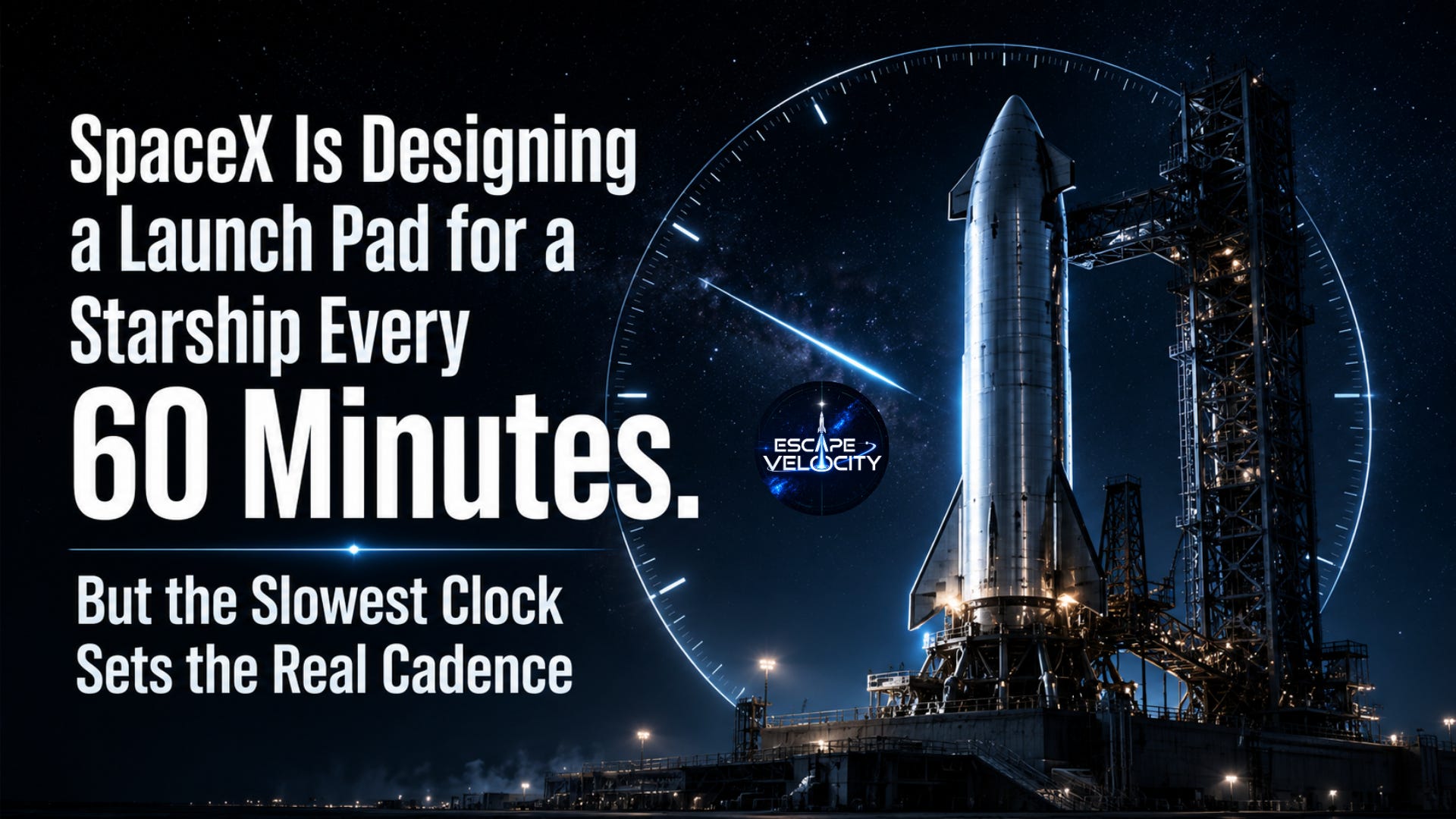
SpaceX’s redesigned hold-down system is built to release the world’s largest rocket, protect itself from 33 engines and reset without refurbishment. Yet an hourly-capable pad is only one component of an industrial system that does not exist at that scale today.
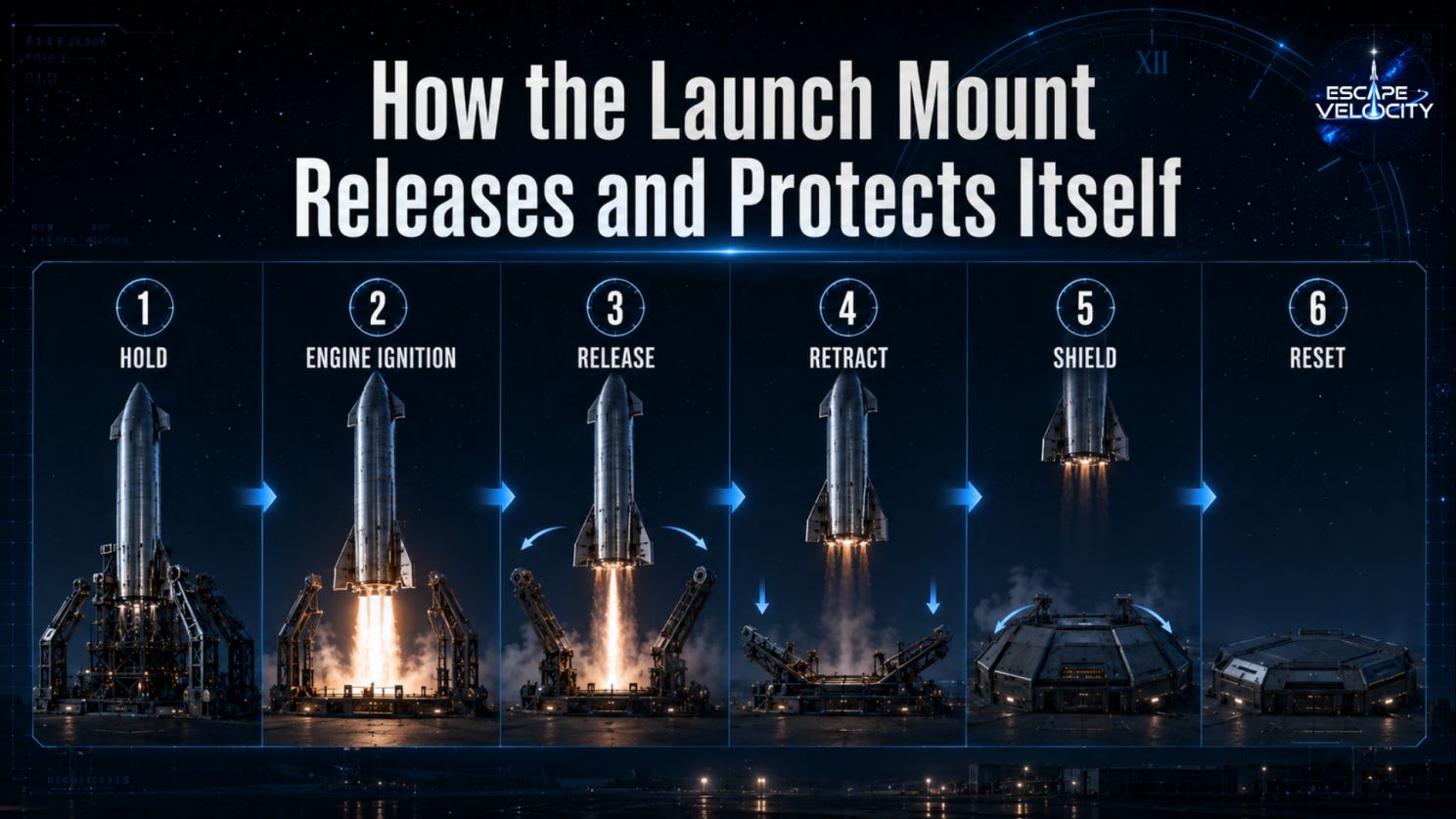
A ring of enormous steel assemblies surrounds the base of SpaceX’s new Starship launch mount. Before flight, the mechanisms help restrain Super Heavy while its engines ignite. At release, they swing rapidly away from the departing booster. Protective structures then close over machinery that would otherwise remain exposed to the heat, pressure and debris generated beneath the vehicle.
The motion is spectacular, but its purpose is practical.
SpaceX is trying to build a launch mount that can release Starship, survive the exhaust of 33 Raptor engines and return to an operational state without lengthy repairs. The company says the new mount and hold-downs have been completely redesigned to improve load sharing, retraction reliability and protection during vehicle departure. It also says the mount’s flame-management surfaces are intended to avoid the ablation and refurbishment required by more sacrificial designs [1].
This infrastructure forms part of a much larger ambition. SpaceX has described a future in which Starship launches every hour carrying as much as 200 tonnes per flight [2].
That statement should not be confused with a present operational capability. SpaceX has not demonstrated hourly Starship launches, and existing regulatory approvals at Starbase remain several orders of magnitude below such a rate. The Federal Aviation Administration’s completed increased-cadence review evaluated up to 25 orbital launches per year from the Texas site, not 24 per day [3].
The more useful question is therefore not whether SpaceX can launch Starship every 60 minutes today.
It is this:
What must a launch site become before an hourly launch is mechanically possible, and would resetting the pad actually be enough to fly again?
The answer reveals why Starship is not merely a reusable rocket project. It is an attempt to convert launch infrastructure from something prepared for individual missions into a reusable industrial machine.
What are the moving mechanisms?
The assemblies visible around the centre of the new launch mount form part of Super Heavy’s hold-down and retraction system.
A rocket cannot simply sit unsecured while its engines begin firing. Engine ignition, thrust buildup and automated health checks occur before the vehicle is released. During this period, the ground structure must restrain the booster and distribute the forces across the mount.
Once the launch system confirms that the required conditions have been met, the sequence appears to work broadly as follows:
Super Heavy remains supported and restrained on the launch mount.
Its Raptor engines ignite and begin building thrust.
Automated systems evaluate the vehicle and engine conditions.
The hold-down mechanisms release the booster.
The assemblies rapidly retract from its departure path.
Protective sections close over actuators and other vulnerable equipment.
The exhaust is channelled through the mount’s flame-management system.
Inspection, drainage, cooling and reset operations can begin.
SpaceX has not publicly released a complete engineering drawing or detailed mechanical description of every moving component. Some interpretations of the visible sequence therefore remain informed observations rather than confirmed descriptions of each subassembly.
What SpaceX has confirmed is the wider design purpose. The company says the mount structure and hold-downs were redesigned to improve force distribution, retraction reliability and protection during the vehicle’s departure [1].
The distinction matters. These mechanisms are not simply giant clamps that “let go” of the rocket. They are load-bearing structures, precision release systems and protective barriers operating within one of the most destructive environments created by any machine.
Why must the booster be restrained?
Super Heavy is powered by 33 liquid-methane and liquid-oxygen Raptor engines [4].
Those engines do not become a stable, unified propulsion system at the first visible sign of ignition. They must start, build pressure and reach acceptable operating conditions while flight computers assess whether the launch can proceed.
A static-fire test makes the principle easier to understand. The engines operate while the rocket remains physically anchored to the ground. During a launch, the restraint lasts only until the system commits to flight, but the structural requirement is similar.
The hold-down system must therefore perform several conflicting tasks:
carry the weight of the stacked vehicle;
withstand transient forces during ignition;
distribute loads without overstressing the mount;
release at the correct moment;
retract quickly enough to avoid the departing booster;
and remain functional after exposure to the launch environment.
A relatively small mechanical fault can stop the entire operation even when the rocket itself is healthy. At low cadence, such failures are delays. At high cadence, they become fundamental constraints on throughput.
Launching every hour requires more than mechanisms capable of moving quickly. It requires them to perform thousands of cycles with extremely low failure rates.
Why do the assemblies close after release?
The launch mount sits directly beneath a booster producing an extraordinary concentration of heat, pressure, acoustic energy and high-velocity exhaust.
Any exposed actuator, cable, valve, filter, sensor or pipe becomes a potential maintenance item. Even hardware outside the centre of the plume can be damaged by reflected pressure waves, hot gases, vibration or debris.
The new mount therefore appears to follow a simple engineering principle:
Remove vulnerable hardware from the plume environment where possible. Shield whatever must remain.
SpaceX says the fluid-handling equipment associated with booster loading has been rearranged. Methane and oxygen connections have been separated, while valves, filters and related equipment have been moved into protected spaces within the side of the launch mount [1].
The moving structures surrounding the centre opening contribute to that protective architecture. Once the booster leaves, they close vulnerable areas rather than leaving machinery fully exposed beneath the rocket.
That protection is not merely about preventing catastrophic failure. Frequent launch operations can also be defeated by cumulative minor damage:
distorted brackets;
overheated seals;
contaminated mechanisms;
damaged wiring;
eroded surfaces;
loosened fasteners;
and sensors requiring replacement or recalibration.
A pad that survives each launch but needs two days of manual inspection is not an hourly pad.
The lesson of Starship’s first integrated launch
The importance of pad survivability became clear during Starship’s first integrated flight test in April 2023.
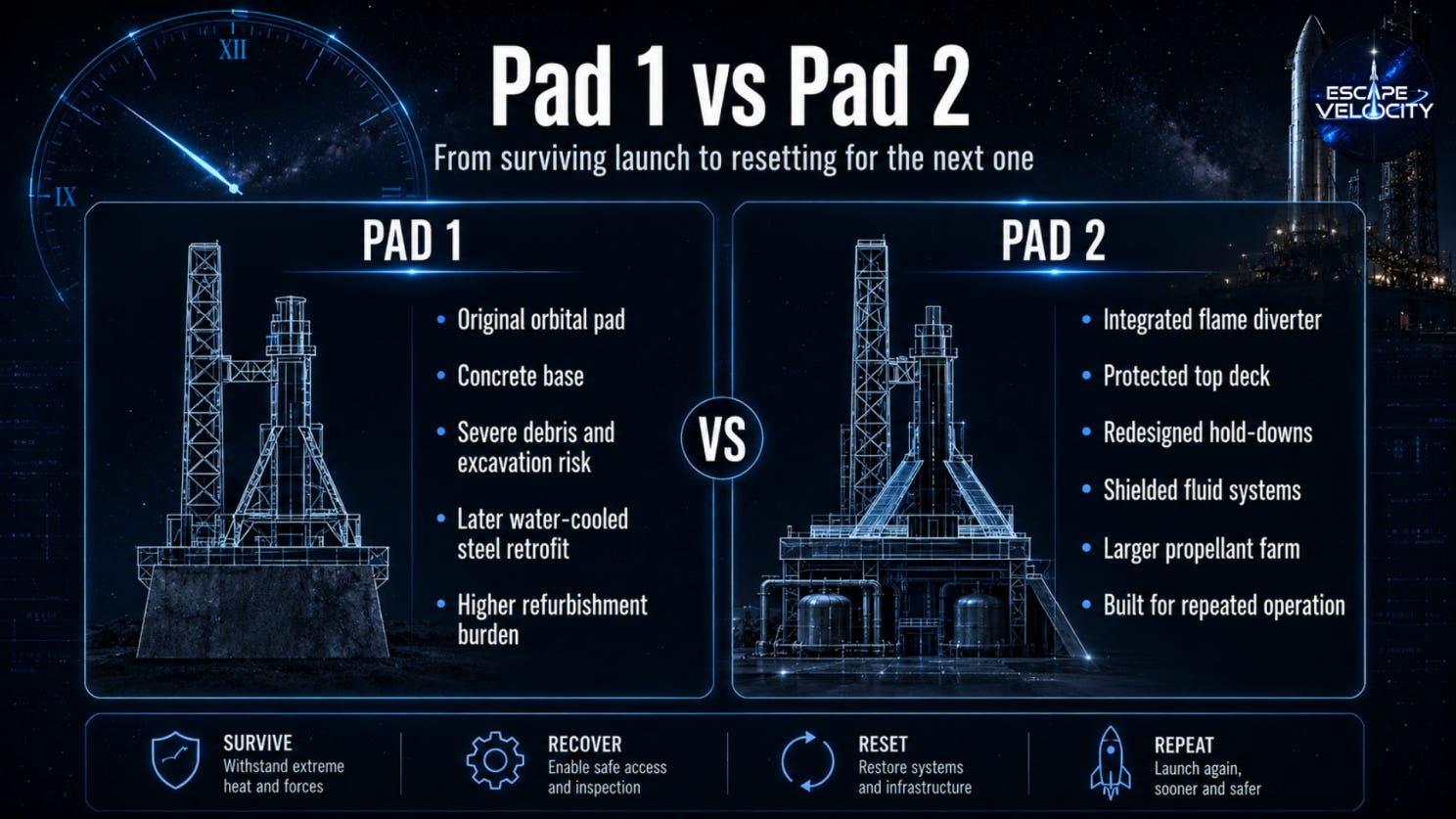
SpaceX’s original orbital launch mount at Starbase did not initially use a conventional flame trench or the more developed water-cooled flame-management system later installed beneath it. When Super Heavy lifted off, the exhaust broke apart the surface below the mount, excavated material beneath it and projected concrete and debris into the surrounding area.
Subsequent research examining material deposited after the launch concluded that the event exposed a launch-pad failure mode in which the plume penetrated the surface and mobilised material from beneath the concrete [5].
SpaceX responded by adding a water-cooled steel flame deflector beneath the existing mount. The system was intended to absorb thermal energy and reduce excavation and debris generation during later launches.
Pad 2 represents a more fundamental redesign.
According to SpaceX, the new installation includes:
a bidirectional flame diverter;
a protected top-deck flame deflector;
redesigned hold-down mechanisms;
separated booster methane and oxygen interfaces;
hardened fluid-control equipment;
a higher-capacity propellant farm;
and modified tower systems [1].
The progression is important:
The original launch architecture encountered severe pad damage.
SpaceX retrofitted a water-cooled steel system beneath the existing mount.
Operational experience exposed additional issues involving protection, interfaces and refurbishment.
Pad 2 was designed around plume control, maintainability and repeated operation from the beginning.
The clamp mechanism is therefore not an isolated novelty. It is one component of an attempt to stop the launch site from becoming the weakest part of a reusable launch system.
The five clocks behind every launch
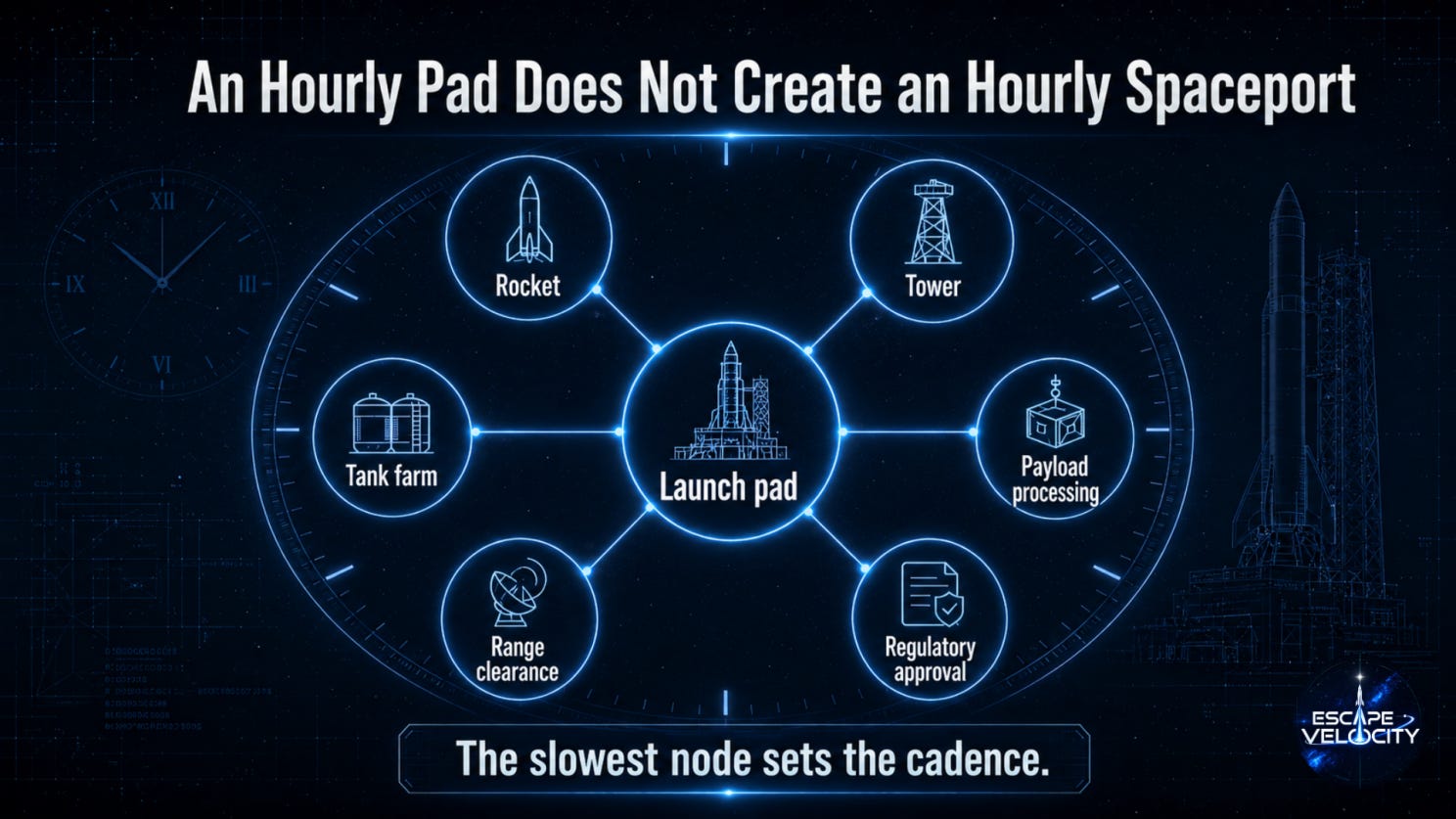
“Launch cadence” sounds like one measure. In reality, it is the result of several clocks running in parallel.
The next launch can occur only when all of them reach zero.
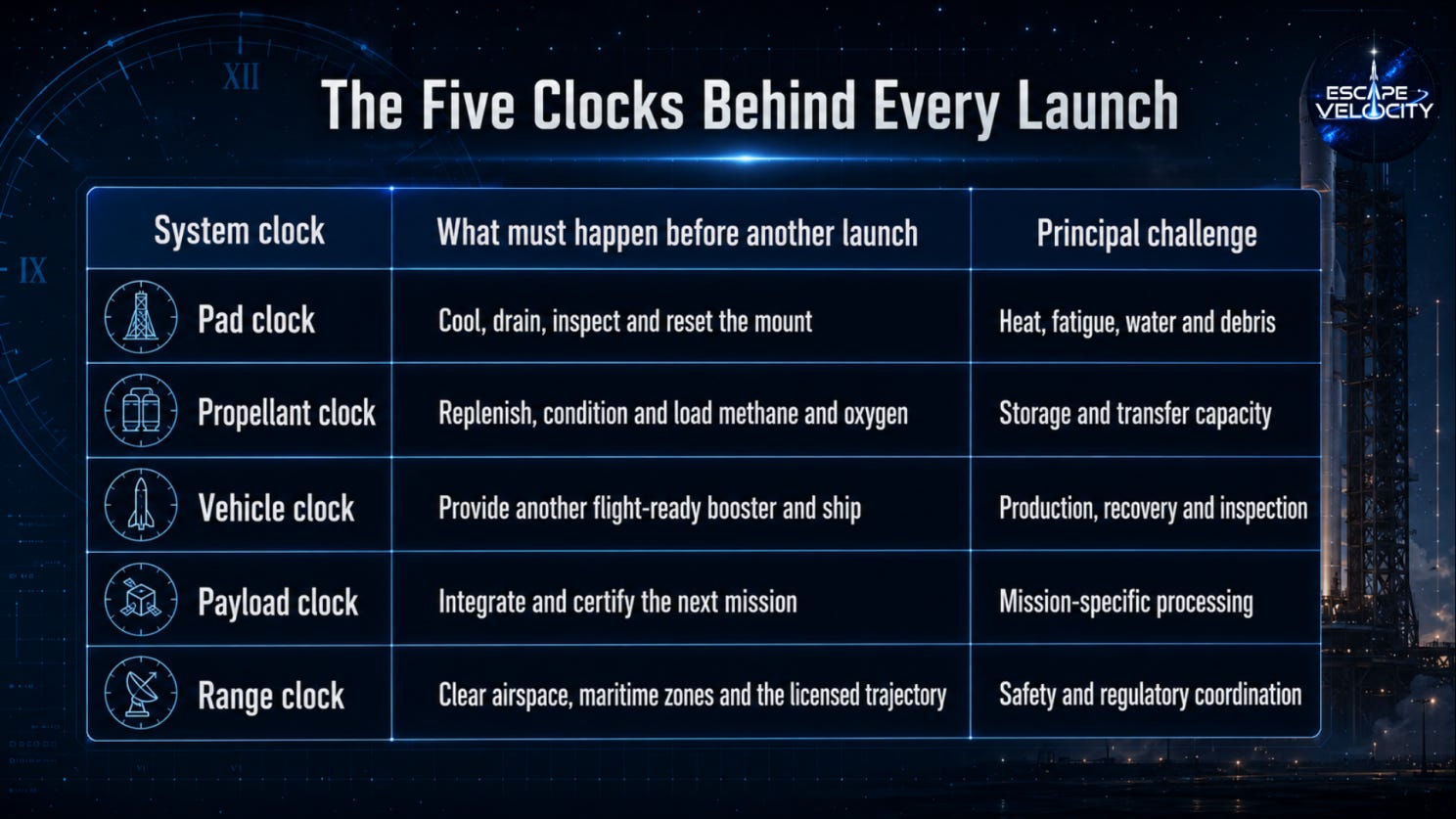
A mount may be mechanically capable of resetting in one hour while the next rocket takes a day to prepare, the tank farm takes several hours to replenish or the launch range remains closed to another operation.
That is why pad recycle time is not the same as launch cadence.
The slowest clock sets the real rate.
Clock one: can the pad cool and reset in 60 minutes?
This is the problem most directly addressed by the new mount.
After a launch, the infrastructure may need to:
discharge or drain water;
clear loose material;
confirm that flame surfaces have not eroded;
inspect hold-downs and quick-disconnect systems;
assess structural deformation;
verify valves and electrical systems;
test actuators;
and restore the mount to its launch configuration.
The central question is not whether the mount survives one nominal flight. It is whether it can survive repeated flights with little or no intervention.
SpaceX says the new flame diverter and top-deck deflector are designed to eliminate ablation and the need to refurbish those surfaces after launch [1]. That is a significant claim because ablation is normally useful precisely because it allows sacrificial material to absorb energy. Removing that refurbishment step requires the permanent structure and cooling system to withstand the environment directly.
The pad will also need to detect damage rapidly.
A genuine one-hour reset would probably depend heavily on built-in monitoring:
strain gauges;
thermal sensors;
pressure measurements;
high-speed cameras;
vibration data;
actuator health monitoring;
and automated comparison with previous launches.
Visual inspection alone would be too slow and too subjective for industrial-scale operations.
Even then, a one-hour reset may apply only after a fully nominal launch. An engine shutting down early, a plume behaving unexpectedly or debris striking the mount could trigger a much longer inspection.
High cadence is therefore governed not only by average turnaround, but by how rarely an abnormal event removes the pad from service.
Clock two: the propellant problem
An hourly Starship system is also a cryogenic logistics system.
The rocket uses liquid oxygen and liquid methane. These propellants must be stored at very low temperatures, transferred into the vehicle at high rates and kept within strict thermal and pressure limits.
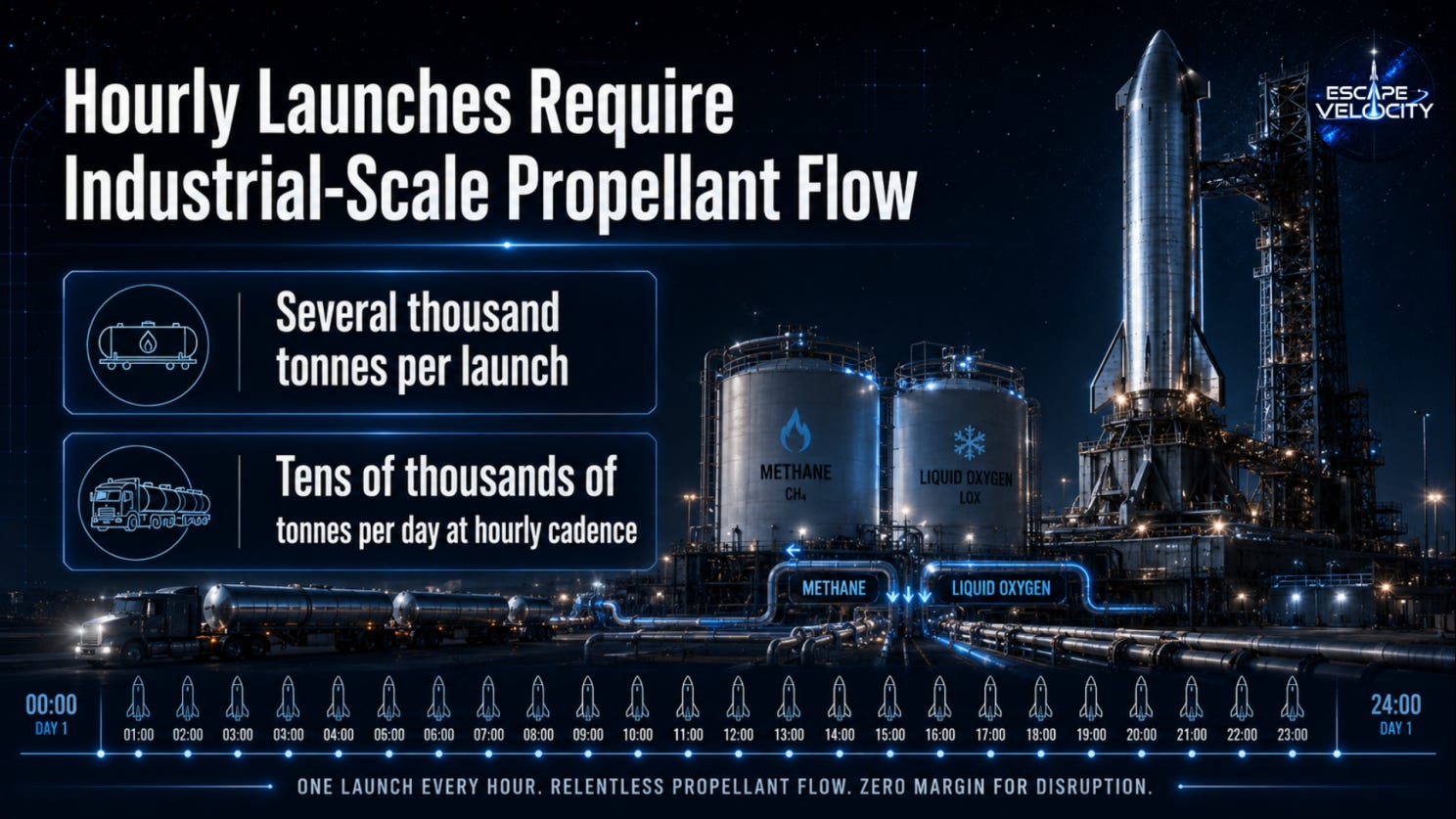
Although precise operational loads vary by vehicle version and mission, a fully fuelled Starship and Super Heavy stack requires several thousand tonnes of propellant. At one launch per hour, the daily requirement would rise into the tens of thousands of tonnes.
That immediately shifts attention from the rocket to the industrial system feeding it.
An hourly architecture would need to answer several questions:
Can the tank farm store enough propellant for consecutive launches?
How quickly can methane and oxygen be replenished?
Is oxygen delivered, produced locally or supplied through another continuous system?
How much propellant is lost through venting, boil-off and conditioning?
Can the tanks and pumps support repeated high-rate loading cycles?
What happens if a vehicle is fuelled and then the launch is scrubbed?
Can another stack be loaded while recovery or maintenance operations continue nearby?
SpaceX says Pad 2’s propellant farm has increased storage capacity and additional pumps intended to enable faster filling [1]. That directly supports higher cadence, but faster vehicle loading is only one part of the chain.
The site must first receive or produce enough propellant to replace what each launch consumes.
At hourly scale, the tank farm becomes as strategically important as the launch mount.
Clock three: where does the next rocket come from?
A pad can reset in 60 minutes only for another vehicle to be unavailable.
There are two broad operating models.
Sequential vehicles
One Starship launches, and a separately prepared booster-and-ship stack follows it.
This model reduces dependence on immediate vehicle reuse, but requires a large fleet, high production rates and somewhere to stage multiple flight-ready vehicles.
Rapid reuse of the same vehicle
A booster returns to the launch site, is caught, inspected, restacked and flown again.
This could reduce fleet requirements, but it places much greater pressure on recovery reliability and inspection time. Engines, tanks, thermal protection, control surfaces and structures must all be cleared for another flight.
SpaceX has demonstrated the tower catch of a returning Super Heavy booster. NASA’s Office of Inspector General notes that Flight 5 demonstrated the ability to catch the booster using the launch tower’s arms [6].
The catch could remove several operational steps:
landing legs need not be carried or inspected;
the booster need not land at a distant zone;
road or maritime transport back to the pad may be avoided;
and the tower could eventually reposition the recovered vehicle.
But the architecture also concentrates risk.
If the tower is needed both to recover one booster and prepare another stack, those operations may conflict. A damaged catch arm could interrupt both recovery and launch preparation. A failed catch could endanger one of the most valuable and difficult-to-replace parts of the site.
The tower may eliminate a transport bottleneck while creating a single-point infrastructure dependency.
Clock four: payload processing
Not every payload can be installed as quickly as a batch of standardised satellites.
A high-cadence Starship system would work most easily with payloads designed around the vehicle’s operations, rather than missions requiring weeks of bespoke preparation at the pad.
Starlink provides the clearest internal demand case. SpaceX controls the rocket, satellites, payload interface and deployment process. That vertical integration allows the company to standardise hardware and remove coordination between separate suppliers.
Tanker Starships could be similarly repeatable. Rather than carrying a unique spacecraft, each flight would perform the same task: deliver propellant to orbit.
Crewed spacecraft, lunar hardware, national-security payloads and scientific missions would be different. They could require additional testing, security, contamination control or certification that does not fit a one-hour ground cycle.
An hourly-capable pad therefore does not imply that every mission can be prepared hourly. It creates capacity that standardised missions may use more effectively than bespoke ones.
Clock five: the launch range
Even a fully prepared vehicle cannot launch without a licensed and cleared path.
Each flight affects some combination of:
controlled airspace;
maritime traffic;
exclusion zones;
local access;
emergency response;
environmental monitoring;
debris-risk areas;
and neighbouring operations.
The FAA’s regulatory role includes public safety, insurance, national-security considerations and environmental effects [3].
Its completed increased-cadence environmental review for Starbase evaluated up to 25 orbital launches and 25 landings of each Starship stage annually. That is a substantial increase over the programme’s earliest test rate, but still averages roughly one launch every two weeks [3].
SpaceX’s hourly vision would imply 8,760 launch opportunities per year from a continuously operating pad. No current Starbase approval approaches that scale.
This does not mean hourly launches are permanently impossible. It means the mechanical design target and the legally permitted operating rate exist on very different timelines.
The launch site may become capable of resetting rapidly long before the surrounding regulatory and airspace system can accommodate that use.
Why SpaceX wants such extreme capacity
An hourly launch mount would make little sense without missions that consume launch capacity at industrial scale.
Three applications stand out.
Orbital refuelling
NASA’s Artemis architecture requires SpaceX to launch a Starship propellant depot and then send multiple tanker Starships to fill it before the lunar lander continues towards the Moon.
A March 2026 NASA Office of Inspector General report says the current concept involves more than ten tanker flights. It says SpaceX is targeting approximately one tanker launch every six days during that campaign, with launches divided between Starbase and Kennedy Space Center [6].
That is far slower than one launch per hour, but it demonstrates why cadence matters. The lunar mission is not enabled by one Starship launch. It depends on a sequence of launches, rendezvous operations and propellant transfers.
Reducing the interval between tanker missions could shorten the campaign and reduce the time during which stored propellant is exposed to boil-off and schedule risk.
Starlink deployment
Starship is intended to carry larger and more capable Starlink satellites than Falcon 9 can accommodate efficiently. SpaceX controls both the launch vehicle and much of the demand it is intended to serve.
Starlink played a similar role in driving Falcon 9 cadence. It provided a large internal payload pipeline that justified investment in manufacturing, reuse and launch operations.
Much larger future infrastructure
SpaceX has connected its hourly-launch ambition to the possibility of moving millions of tonnes into orbit annually, including large satellite and computing constellations [2].
These are not current market volumes. They are demand assumptions about a future in which dramatically lower launch costs stimulate entirely new categories of space infrastructure.
That distinction is important. SpaceX is not merely designing a pad to serve today’s launch market more frequently. It is designing around the belief that radically greater supply will help create radically greater demand.
Why one fast pad is not enough
Transport systems normally achieve high throughput through redundancy and parallel operations, not by requiring one asset to perform continuously without interruption.
Airports use multiple gates, taxiways, maintenance areas and, where possible, more than one runway. Container ports use several berths and cranes. Factories use parallel production cells and spare capacity.
An hourly Starship system would probably need the same logic.
Multiple pads could allow SpaceX to:
launch from one mount while another is inspected;
separate recovery operations from launch preparation;
continue operating when one tower enters maintenance;
divide tanker, satellite and test flights;
and prevent one failed mechanism from stopping the entire system.
Pad 2 therefore matters not only because it may be better than Pad 1. It begins to create redundancy at Starbase.
The long-term architecture may depend less on forcing one mount to operate every hour and more on coordinating several launch cells, each capable of rapid reuse.
A 60-minute system-level cadence could eventually mean one Starship launch somewhere within a network every hour, rather than the same pad launching precisely once every 60 minutes.
What Falcon 9 already taught SpaceX
Falcon 9 proved that recovering a booster is not the same as creating a fully reusable launch system.
Its first stages can fly repeatedly, yet operational cadence still depends on:
upper-stage production;
payload availability;
drone ships or landing zones;
fairing recovery;
launch-range scheduling;
refurbishment;
and pad availability.
SpaceX increased Falcon launch rates through a combination of booster reuse, multiple launch sites, standardised Starlink missions and continued production of expendable hardware.
Starship attempts to push the model further by recovering both major stages, increasing payload capacity and integrating the tower, mount and propellant systems more tightly into the vehicle architecture.
The relevant lesson is that reuse removes some bottlenecks but exposes others.
Once boosters no longer need months of production before every flight, pad reset, propellant supply, payload flow and regulatory clearance become more visible constraints.
Starship’s new launch mount is designed for that next stage of the problem.
What the hourly claim really means
SpaceX’s statement about launching every hour is best interpreted as a long-term system ambition, not a near-term operating schedule and not necessarily a guarantee that one individual mount will conduct 24 launches every day.
Its value is as a design requirement.
An engineering team planning for a few launches per year might tolerate:
replaceable flame surfaces;
exposed equipment;
extensive manual inspection;
slow propellant replenishment;
and a tower that becomes unavailable during maintenance.
A team designing for hourly operations cannot.
The target forces SpaceX to remove refurbishment tasks, shield machinery, add pumps, separate fluid systems, automate inspection and create redundancy before the actual flight rate requires all of it.
This is why apparently excessive mechanisms matter. Their purpose is not merely to support the next launch. They are intended to avoid becoming the reason the launch after that cannot happen.
Verdict: mechanically plausible, systemically unproven
SpaceX’s redesigned mount makes rapid pad reuse more credible.
The new hold-down system addresses load distribution, release reliability and protection. The flame diverter and top deck are intended to avoid routine ablation and refurbishment. Propellant systems have been separated and shielded. The tank farm has been expanded to support faster filling [1].
Those are real engineering steps towards a reusable launch site.
But they do not yet establish an hourly launch capability.
The complete system would also need:
abundant flight-ready vehicles;
rapid and reliable inspection;
industrial-scale methane and oxygen supply;
repeatable payload processing;
several launch and recovery assets;
permissive weather and range conditions;
and a regulatory framework capable of handling thousands of annual operations.
Today, the difference between SpaceX’s hourly vision and Starbase’s evaluated annual cadence remains enormous.
The new mechanism should therefore be understood neither as a gimmick nor as proof that hourly launches have arrived.
It is evidence that SpaceX is designing the ground system around a future operating model far beyond current demand and current regulatory capacity.
The mount may eventually be able to reset in 60 minutes. But rapid launch is not one engineering problem. It is a chain of clocks.
The pad, tank farm, rocket, tower, payload operation and launch range must all be ready.
The slowest clock sets the real cadence.
References
[1] SpaceX, Starship Version 3 and Pad 2 technical update, describing the redesigned launch mount, hold-downs, flame diverter, protected fluid systems, tower modifications and expanded propellant farm. (SpaceX)
[2] SpaceX, company update describing a long-term Starship architecture involving launches every hour and payloads of up to 200 tonnes per flight. (SpaceX)
[3] Federal Aviation Administration, Starship/Super Heavy project and increased-cadence environmental review at Boca Chica, including evaluation of up to 25 annual orbital launches and landings. (Federal Aviation Administration)
[4] NASA, Artemis Mission Progresses with SpaceX Starship Test Flight, confirming Super Heavy’s 33 liquid-methane and liquid-oxygen Raptor engines. (NASA)
[5] B. Dotson et al., “A New Launch Pad Failure Mode: Analysis of Fine Particles from the Launch of the First Starship Orbital Test Flight,” examining material distributed following the April 2023 launch. (Federal Aviation Administration)
[6] NASA Office of Inspector General, NASA’s Management of the Human Landing System Contracts, March 2026. The report describes the Starship depot-and-tanker architecture, more than ten planned tanker flights, a target interval of one flight every six days and the demonstrated Super Heavy tower catch.