
Can Lightning Strike Twice? The Physics of a Rocket Becoming a Flying Lightning Rod

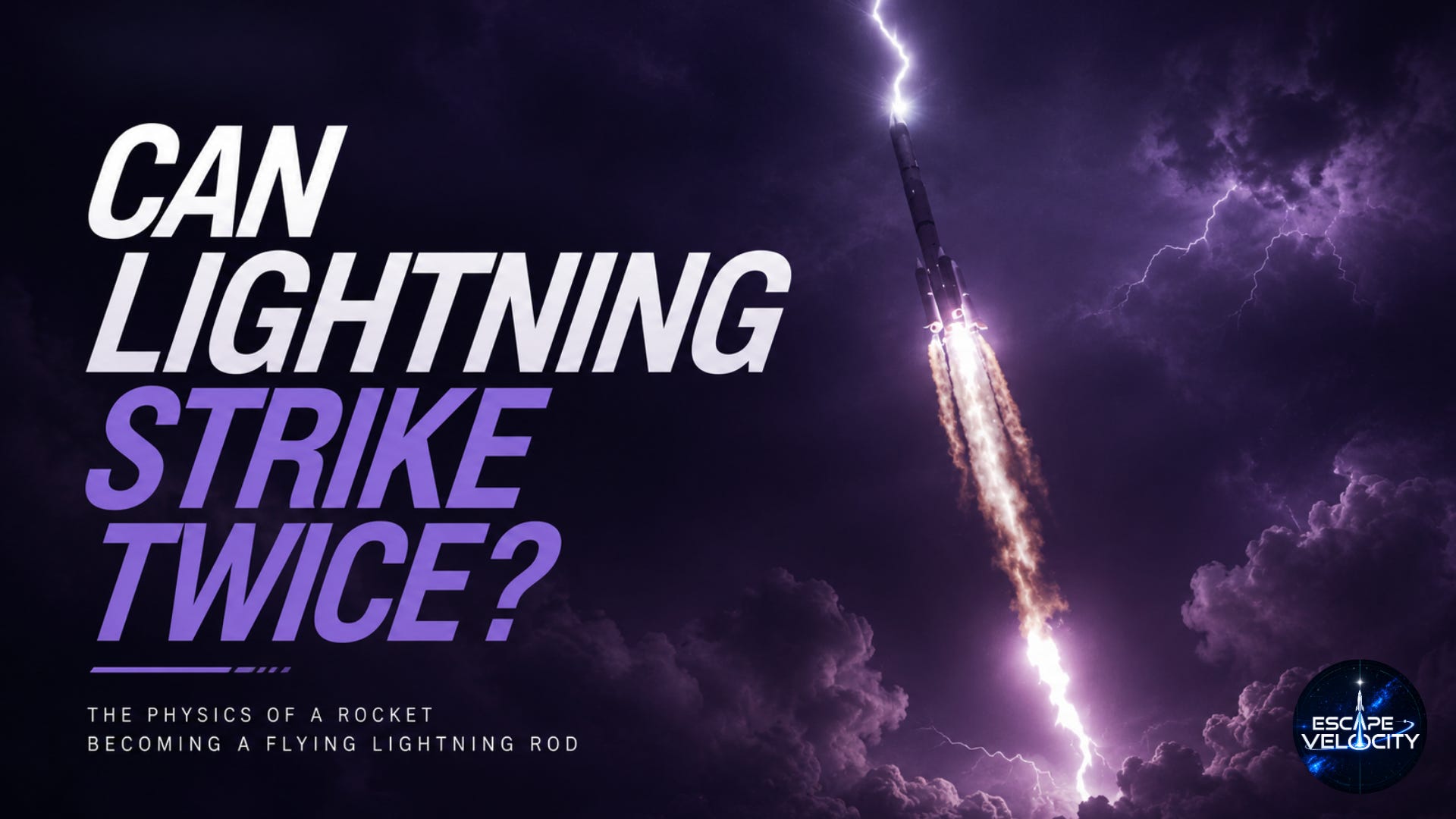
(Image credit: Zhou Quan/VCG via Getty Images)
On 23 July 2026, a Long March 3B rocket rose from China’s Xichang Satellite Launch Center carrying the Tianlian II-06 communications-relay satellite.
Around 30 seconds after liftoff, the sky appeared to split open.
A brilliant lightning channel descended through the clouds, intersecting the rocket’s glowing ascent path as spectators below reacted in disbelief. Yet the Long March continued flying. Its upper stages performed normally, and Tianlian II-06 was delivered successfully toward geostationary orbit [1].
It is an extraordinary photograph. But the most interesting part is not simply that lightning apparently struck a rocket.
It is that the rocket may have helped create the lightning itself.
A launch vehicle is not merely a passive object crossing a storm. It is a tall, electrically conductive body moving rapidly through charged clouds while trailing a hot, ionised exhaust plume. Under the right atmospheric conditions, the vehicle can distort the surrounding electric field so severely that it completes a discharge path which did not previously exist.
In other words, the rocket does not always get unlucky enough to meet a lightning bolt.
Sometimes it gives the lightning somewhere to go.
What happened above Xichang?
The Long March 3B launched from Xichang in Sichuan province on 23 July 2026. The mission carried Tianlian II-06, a data-relay satellite intended to support communications with China’s Tiangong space station and other crewed missions [1].
Approximately 30 seconds into the flight, cameras recorded a luminous electrical channel running between the cloud system and the rocket’s trajectory.
The rocket nevertheless completed its mission successfully [1].
As of publication, Chinese authorities have not released a detailed electrical-event reconstruction specifying:
the current carried by the discharge;
the exact attachment points;
the rocket’s altitude at the moment of the event;
whether the channel directly contacted the vehicle or attached primarily to its conductive exhaust;
the number of return strokes;
or whether any onboard systems recorded temporary electrical disturbances.
That means the exact altitude cannot responsibly be stated as a confirmed figure.
A rough trajectory-based estimate would place a Long March 3B several kilometres above the ground after roughly 30 seconds, but the actual value would depend on its programmed pitch manoeuvre, acceleration profile and atmospheric conditions. Until flight data are released, any precise altitude circulating online should be treated cautiously.
The visual geometry is also deceptive. A two-dimensional image cannot by itself prove exactly where a lightning channel lies relative to a distant vehicle.
However, the event closely resembles previously documented cases of rocket-triggered lightning: the vehicle enters an electrically active cloud region, its conductive structure and plume intensify the local electric field, and a discharge propagates along or close to the ascent path.
The rocket may therefore have functioned less like a target and more like a flying lightning rod.
How can a rocket trigger lightning?
Lightning begins with electrical charge separation inside a cloud.
Collisions between ice crystals, graupel, supercooled droplets and other particles help create regions of different electrical polarity. A large potential difference develops between parts of the cloud, or between the cloud and the ground.
Air is normally a good electrical insulator. Even a strong electric field does not necessarily produce a visible lightning flash because the field may remain below the threshold required to form a self-sustaining ionised channel.
Then the rocket arrives.
1. The vehicle concentrates the electric field
A rocket is a long conductive structure, often tens of metres tall, with relatively sharp geometric features.
When placed in an external electric field, charge redistributes over its surface. The field becomes especially concentrated near extremities such as the nose, fins, engine region and protruding structures.
This is the same broad electrostatic principle that makes lightning rods effective.
The rocket’s movement through the cloud can raise the local electric field sufficiently for corona discharge and streamer formation to begin.
2. The exhaust plume extends the conductive system
A rocket plume contains hot combustion products, charged particles, electrons and ions. Its conductivity is not uniform, and it is not equivalent to a solid copper wire, but it can substantially alter the electrical environment around the vehicle [2].
The plume effectively lengthens the electrically influential structure far behind the rocket.
Rather than the atmospheric field acting across the rocket’s physical length alone, it can interact with a rocket-plume system extending hundreds of metres or more through the cloud.
NASA research following earlier accidents concluded that launch vehicles passing through sufficiently strong cloud electric fields can initiate lightning even when natural lightning is not occurring nearby [2][3].
3. Leaders propagate away from the vehicle
Once the field becomes strong enough, ionised channels known as leaders can develop from one or both ends of the rocket-plume system.
One leader may propagate toward a charged region of the cloud while another moves toward the ground or an oppositely charged region.
When the electrical path connects, a high-current return stroke can travel through the channel.
To observers, it appears that a bolt has suddenly found the rocket.
Electrically, the rocket may have helped bridge a gap in the atmosphere.
Did the lightning travel through the rocket?
Possibly, but that does not mean every ampere followed a single path through the centre of the vehicle.
Lightning current can divide between:
the rocket’s metallic skin;
structural joints;
designated bonding paths;
engine and interstage structures;
cable shields;
plumbing;
the ionised exhaust;
and external plasma surrounding the vehicle.
The engineering objective is not to prevent all current from touching the rocket. That may be impossible once a direct attachment occurs.
The objective is to control where the current flows and prevent dangerous voltage differences from developing across sensitive components.
A vehicle can survive a large current flowing over its external structure while still being vulnerable to a much smaller transient coupled into the wrong signal wire.
This distinction explains why one lightning-struck rocket can continue normally while another can be destroyed by a single corrupted computer word.
How many rockets have actually been struck by lightning?
There is no complete global public database covering every military, suborbital, experimental and orbital launch.
However, among well-documented orbital launch events, four major cases stand out.
Apollo 12 experienced two distinct discharges during one launch, so the historical record contains at least five confirmed or strongly evidenced launch-related lightning flashes across four orbital missions.
1. Apollo 12, 14 November 1969
Apollo 12 launched aboard a Saturn V from Kennedy Space Center in cloudy, rainy conditions.
At 36.5 seconds after liftoff, when the vehicle was approximately 6,000 to 6,600 feet above the ground, the rocket triggered a lightning discharge. A second electrical event occurred at 52 seconds, at approximately 13,000 feet [4][5].
The first strike produced widespread electrical anomalies inside the command module:
all three fuel cells disconnected;
the main electrical buses experienced undervoltage;
alternating-current buses were disrupted;
telemetry became scrambled;
multiple warning lights activated;
and the spacecraft’s inertial platform lost its reference [4].
The Saturn V’s own guidance system continued operating.
Flight controller John Aaron recognised the strange telemetry pattern and instructed the crew to switch the Signal Conditioning Equipment to its auxiliary power mode. Astronaut Alan Bean located the obscure switch, telemetry returned, and the crew gradually restored the spacecraft’s electrical systems [5].
Apollo 12 reached orbit, underwent extensive checks and continued to the Moon.
Post-flight analysis found that some non-essential sensors and instruments had suffered permanent effects, but the mission’s critical systems remained usable [1].
Impact
Severe temporary electrical disruption, limited permanent equipment damage and a narrowly avoided mission abort.
Recovery
The spacecraft’s systems were reset in flight, its pyrotechnic circuits were checked in Earth orbit, and the mission continued successfully.
Engineering significance
Apollo 12 showed that a rocket could trigger lightning even without flying through an obvious mature thunderstorm.
2. Atlas-Centaur 67, 26 March 1987
Atlas-Centaur 67 launched from Cape Canaveral carrying the US Navy’s FLTSATCOM-6 communications satellite.
Around 48 to 49 seconds after liftoff, the vehicle triggered a cloud-to-ground flash containing at least four return strokes [6].
The lightning did not immediately explode a propellant tank or tear the rocket apart.
Instead, an electromagnetic transient coupled into wiring connected to the Centaur digital computer unit.
The transient altered a single memory location.
That corrupted value affected the calculation of the Atlas engine’s yaw command. The computer ordered an extreme engine-gimbal movement, producing a rapid attitude deviation and excessive aerodynamic loading [6][7].
The vehicle broke apart.
Impact
Complete loss of the launch vehicle and payload.
Recovery
There was no physical recovery of the mission. The investigation instead produced major changes to launch-weather policy and lightning-risk assessment.
Engineering significance
Atlas-Centaur 67 demonstrated that the most dangerous consequence of lightning may not be direct structural damage.
One electromagnetic disturbance, injected into one vulnerable circuit, can corrupt guidance and destroy the entire vehicle.
The incident became a central basis for the strict Lightning Launch Commit Criteria subsequently adopted at US launch ranges [3].
3. Soyuz-2.1b, 27 May 2019
A Soyuz-2.1b launched from Russia’s Plesetsk Cosmodrome carrying a Glonass-M navigation satellite.
Shortly after liftoff, video showed lightning intersecting the vehicle and its exhaust trail.
The Soyuz continued flying and successfully delivered the satellite to orbit.
Public reporting indicated that the launch vehicle operated normally despite the event, but Russia did not release an Apollo-style detailed technical reconstruction showing current paths or internal transient measurements.
Impact
No publicly reported mission-critical damage.
Recovery
No in-flight recovery action was publicly reported as necessary. The mission continued normally.
Engineering significance
The event demonstrated that a modern launch vehicle can tolerate at least some direct or plume-associated lightning events without losing guidance, propulsion or payload delivery.
4. Long March 3B, 23 July 2026
The Long March 3B carrying Tianlian II-06 encountered the apparent lightning event approximately 30 seconds after liftoff from Xichang [1].
It successfully delivered the satellite to its planned orbit.
Impact
No publicly reported mission-critical impact.
Recovery
No recovery action has been disclosed. The vehicle appears to have continued through its normal flight sequence.
Engineering significance
The case provides rare modern imagery of a launch vehicle apparently forming part of an atmospheric electrical discharge while remaining operational.
It also raises questions about how China applies weather constraints at Xichang and how the Long March electrical architecture handles lightning-induced transients.
So has lightning only hit four rockets?
Not necessarily.
These are the best-known, publicly documented orbital-launch cases.
Smaller rockets, missiles and sounding rockets have also operated in electrically active environments, but records may be incomplete, classified, poorly instrumented or described only in local reporting.
The US record is unusually clear because Apollo 12 and Atlas-Centaur 67 produced extensive NASA investigations.
NASA states that, after Atlas-Centaur 67 and the rigorous implementation of updated launch criteria, no US launch vehicle has intercepted or triggered lightning during ascent [1][3].
That is evidence not that the hazard disappeared, but that weather rules became effective at keeping rockets away from the atmospheric conditions in which it occurs.
Why did some rockets survive while Atlas-Centaur did not?
A lightning flash is not a single standardised engineering load.
Its consequences depend on at least six variables.
Attachment point
A strike attached to a robust metallic skin may be less dangerous than one attaching near:
an antenna;
an exposed sensor;
a separation interface;
a composite panel;
a propellant vent;
an engine controller;
or a payload electrical connection.
Current waveform
Peak current matters, but so do:
current rise time;
total transferred charge;
pulse duration;
number of return strokes;
and continuing current.
A rapidly changing current creates intense electromagnetic fields capable of inducing voltage in nearby conductors.
Current path
The danger increases when the vehicle lacks a low-impedance, predictable path around sensitive equipment.
Poor bonding between panels can force current across joints, fasteners or cables which were never intended to carry it.
Electrical architecture
Modern avionics can use:
shielded cables;
fibre-optic data links;
isolated power supplies;
surge suppression;
transient protection devices;
redundant computers;
error-detecting memory;
watchdog logic;
and fault-tolerant guidance software.
These measures do not make a rocket invulnerable, but they reduce the chance that one induced pulse becomes a catastrophic command.
Vehicle materials
Traditional aluminium structures naturally provide substantial electromagnetic shielding.
Composite structures can require additional conductive meshes, foils and bonding provisions because carbon-fibre laminates do not necessarily conduct or distribute lightning current as predictably as a continuous metal shell.
Flight condition
At 30 to 50 seconds after liftoff, a rocket may be approaching the region of maximum aerodynamic pressure.
A small guidance disturbance at this moment can produce enormous structural consequences.
Atlas-Centaur 67 did not fail merely because its computer issued the wrong command. It failed because the resulting attitude change occurred while the atmosphere was still dense enough to impose destructive aerodynamic loads.
Do engineers design rockets for lightning?
Yes, but the primary defence is still not to launch into conditions capable of producing it.
Lightning engineering uses several layers.
1. Launch-weather avoidance
NASA, the US military and commercial launch operators use Lightning Launch Commit Criteria designed to prevent both natural and rocket-triggered lightning [3].
The criteria consider more than whether lightning has recently been observed.
They assess conditions including:
cumulonimbus clouds;
thick cloud layers;
anvil clouds;
precipitation;
freezing levels;
cloud electric fields;
nearby lightning;
smoke plumes;
disturbed weather;
and the rocket’s projected path through those regions.
A cloud can contain a dangerous electric field without producing natural lightning.
That is why “there was no thunderstorm” is not sufficient evidence that launch conditions are electrically safe.
2. Ground lightning protection
While the rocket is on the pad, towers, catenary wires and grounding systems are used to intercept ordinary lightning and route current into the ground.
These systems protect a stationary vehicle.
Once the rocket rises above the protection system, it becomes the dominant tall conductive object in its local environment.
3. Bonding and current routing
Conductive vehicle sections are electrically bonded so that lightning current can move across interfaces without producing damaging voltage differences.
Engineers pay particular attention to:
hinges;
access panels;
stage joints;
umbilical interfaces;
plumbing;
cable trays;
fasteners;
and composite-to-metal transitions.
4. Electromagnetic shielding
Avionics compartments and cable shields reduce the electromagnetic energy reaching sensitive circuits.
A largely metallic rocket body can behave partly like a Faraday cage, encouraging external current to flow around protected internal volumes.
5. Surge and transient protection
Electrical interfaces may include filters, clamps and isolation devices designed to absorb or divert short-duration voltage spikes.
Critical signals can be designed so that an implausible single command is rejected rather than acted upon immediately.
6. Redundancy and fault tolerance
Guidance computers may cross-check outputs or use multiple voting channels.
A modern flight computer should not allow one flipped bit to issue an unrecoverable engine command without validation, although the precise architecture varies between vehicles.
7. Lightning testing
Spacecraft and launch-vehicle components can be exposed to simulated lightning currents and electromagnetic transients.
NASA tested Space Shuttle lightning attachment points and investigated how current might reach the nose, wings, thermal-protection system and propulsion elements [8].
Separate high-current testing demonstrated protective methods capable of diverting simulated currents of approximately 50 kiloamps around parts of the Shuttle’s external tank [9].
So, yes, engineers account for lightning.
But they generally design for residual risk after weather avoidance, not for routine launches through violent thunderstorms.
What would happen to the payload?
A payload sits inside the fairing, physically separated from the outside environment, but it is not electrically isolated from the launch vehicle in every sense.
Lightning can affect a payload through:
conducted current through structural attachment points;
induced voltage in harnesses;
electromagnetic radiation penetrating apertures;
common power or data interfaces;
electrostatic discharge;
corrupted commands;
or disturbances in the upper-stage avionics controlling payload deployment.
A well-designed payload uses its own shielding, grounding strategy, surge protection and fault-tolerant electronics.
Sensitive instruments may remain powered down during ascent, reducing their immediate exposure.
The most vulnerable systems can include:
high-gain analogue detectors;
unshielded sensor inputs;
magnetometers;
radio receivers;
deployable mechanisms;
pyrotechnic initiation circuits;
and memory devices without adequate error correction.
The payload may therefore survive even if the launcher experiences substantial electrical disturbance.
Conversely, a rocket can remain controllable while a delicate instrument suffers latent damage that is discovered only after deployment.
What other bizarre weather events have affected launches?
Most launch-weather delays involve ordinary problems: high winds, thick clouds, thunderstorms or poor visibility.
A few cases are considerably stranger.
A hailstorm cratered a Space Shuttle’s external tank
On 26 February 2007, severe thunderstorms struck Space Shuttle Atlantis while it stood on Launch Pad 39A awaiting the STS-117 mission.
Hail measuring roughly 0.3 to 0.8 inches in diameter hit the vehicle, while peak winds reached approximately 62 knots [10].
The impacts damaged the insulating foam covering the external tank and produced smaller defects elsewhere on the stack.
This was not cosmetic.
The foam helped insulate cryogenic liquid oxygen and liquid hydrogen and limit ice formation. Damaged foam could detach during ascent and strike the orbiter’s thermal-protection system.
Atlantis was rolled back to the Vehicle Assembly Building for inspection and repair, delaying the mission by several months [10][11].
An earlier hail event in 1999 had similarly damaged the STS-96 external tank badly enough to require rollback [12].
The weather did not strike the Shuttle during flight. It altered the aerodynamic and debris risk before launch.
That is a reminder that a rocket can be damaged by weather while doing absolutely nothing.
A tropical storm damaged a rocket inside its assembly building
In 2006, the Space Shuttle Atlantis was sheltering inside Kennedy Space Center’s Vehicle Assembly Building as Tropical Storm Ernesto approached.
The building was designed to withstand severe weather, but the event illustrated an awkward fact: launch vehicles may remain vulnerable even after being rolled indoors.
Huge doors, cranes, platforms and ventilation systems must protect a structure taller than many office buildings. Wind-driven rain, pressure changes, debris and building movement can all become engineering concerns.
A hurricane shelter for a rocket is itself an enormous aerospace system.
Upper-level winds can bend a rocket even when the pad seems calm
Surface weather can appear acceptable while powerful winds exist several kilometres above the launch site.
More important than wind speed alone is wind shear: a rapid change in wind speed or direction with altitude.
A rocket travelling upward through different air streams experiences changing angles of attack and bending loads. These loads can combine with structural vibration and guidance corrections.
Launch teams therefore release weather balloons and use wind-profile data to construct a detailed atmospheric model shortly before flight.
In extreme cases, a launch may be delayed under a blue sky because the invisible winds above the pad would place unacceptable loads on the vehicle.
Ice can fall from the rocket itself
Cryogenic launch vehicles contain propellants at extremely low temperatures.
Moisture from the humid surrounding air can condense and freeze on exposed surfaces, pipes and tank structures.
Ice shedding during launch can become high-speed debris.
The Space Shuttle’s external tank insulation was partly intended to minimise this problem. Engineers also inspected the vehicle for dangerous ice formations before launch.
The bizarre part is that a rocket can effectively manufacture its own local weather: frost, fog, condensation and falling ice produced by propellant temperatures rather than the regional atmosphere.
Weather can prevent a rocket from coming home
The Space Shuttle required acceptable conditions not just at its launch site but at potential emergency landing locations.
A mission could be delayed because of:
crosswinds at Kennedy;
rain at a transatlantic abort site;
cloud cover at Edwards Air Force Base;
or thunderstorms at alternative runways thousands of kilometres away.
For crewed winged spacecraft, launch weather can therefore become a continental-scale constraint.
Volcanic ash creates a less visible launch threat
Volcanic ash is not ordinary soft smoke.
It consists of fine abrasive particles of rock and glass. In aviation, ash can erode surfaces, contaminate systems and damage turbine engines.
A launch vehicle passing through an ash cloud could face:
erosion of exposed surfaces;
contamination of optical sensors;
electrical charging;
deposits in moving mechanisms;
uncertain engine interactions;
and impaired ground tracking.
Unlike a thunderstorm, an ash cloud may be difficult to see clearly from the ground, especially at night or when dispersed.
Launch ranges therefore depend on meteorological satellites and atmospheric transport models as well as local observation.
The smaller tangent above the atmosphere: space weather
Once the rocket rises above terrestrial weather, it enters another environment capable of disrupting electronics.
Space weather is driven primarily by solar activity.
Solar flares and coronal mass ejections can produce high-energy particles, intense radiation and geomagnetic disturbances.
In January 2014, an Antares launch from NASA’s Wallops Flight Facility was postponed because elevated space-radiation levels could have interfered with the rocket’s onboard computer systems [13].
The concern was not that radiation would physically push the rocket off course.
High-energy particles can pass through electronic devices and deposit charge in semiconductor structures. This can cause:
single-event upsets, where a memory bit changes state;
processor resets;
false commands;
latch-up;
sensor noise;
or permanent component damage.
The physics is strangely similar to the Atlas-Centaur lesson.
A launch vehicle does not have to be physically torn apart by the environment. One altered electrical state in the wrong place may be sufficient.
Satellites are especially vulnerable because they remain exposed for years.
Engineers use:
radiation-hardened components;
error-correcting memory;
redundant processors;
watchdog timers;
shielding;
safe modes;
and periodic memory scrubbing.
Space weather can also disturb the ionosphere, degrading GPS accuracy and radio communications precisely when a vehicle depends on tracking and telemetry.
Atmospheric lightning and solar radiation are very different phenomena, but both turn the electromagnetic environment into a systems-engineering problem.
Where is rocket-triggered lightning most likely?
The risk is highest where three ingredients overlap:
frequent electrically active clouds;
launch trajectories passing through those clouds;
operational pressure to launch despite marginal weather.
Geographic lightning frequency alone does not determine launch risk because operators can delay launches.
Nevertheless, several launch regions deserve attention.
Florida
Kennedy Space Center and Cape Canaveral sit in one of the most lightning-active parts of the United States.
Warm, humid air, sea-breeze convergence and intense summer convection produce frequent thunderstorms.
Florida’s weather helped make NASA and the US Air Force world leaders in launch-range lightning detection, field mills and weather rules.
French Guiana
Europe’s spaceport near Kourou lies close to the equator in a humid tropical environment.
Frequent convection, heavy rain and thunderstorms require extensive weather monitoring.
Its near-equatorial location is excellent for orbital performance but meteorologically demanding.
Southern China
Xichang lies in a mountainous region of Sichuan where moisture, terrain-driven uplift and seasonal convection can create complex cloud and electrical conditions.
The surrounding terrain can also complicate direct visual observation and radar interpretation.
China’s Wenchang launch site on tropical Hainan faces its own combination of lightning, monsoonal rainfall and typhoon exposure.
Japan
Tanegashima Space Center experiences humid maritime weather, heavy rain and typhoon-related constraints.
India
Sriharikota’s tropical coastal environment exposes it to monsoonal storms, lightning and cyclonic weather.
Tropical Africa and northern South America
Some of the world’s highest lightning frequencies occur in tropical Africa and around Lake Maracaibo in Venezuela [14][15].
These regions would demand especially conservative launch-weather operations.
What if we launched a rocket from Catatumbo?
Catatumbo lightning occurs around the Catatumbo River and Lake Maracaibo in Venezuela.
Thunderstorms form there on roughly 160 nights per year and can continue for up to nine hours, producing remarkably persistent lightning activity [14].
The phenomenon results from an exceptional combination of:
warm, moisture-rich air over Lake Maracaibo;
surrounding mountain topography;
nighttime circulation;
atmospheric instability;
and repeated convective development.
It is sometimes called the “Lighthouse of Maracaibo” because its frequent flashes were historically visible to sailors.
So what would happen if a launch complex were built there?
The rocket would not be struck on every launch
Even at Catatumbo, lightning is not spatially and temporally uniform.
Launch operators would select quieter periods using:
weather radar;
lightning-mapping arrays;
satellite observations;
electric-field mills;
atmospheric soundings;
cloud measurements;
and strict commit criteria.
The site could technically launch rockets by waiting for safe windows.
But launch availability would likely be poor during the most active seasons and times of day.
The vehicle could trigger lightning before natural lightning began
The most important risk would not necessarily be flying through an already visible lightning storm.
A cloud containing a strong electric field may be close to electrical breakdown without yet producing a natural flash.
A tall rocket and its plume could provide the missing conductive pathway.
At Catatumbo, the frequency of strongly electrified cloud systems would increase the number of periods during which this triggering mechanism was possible.
Ground infrastructure would face constant exposure
The launch tower, propellant farms, communications systems, radars, power networks and payload-processing buildings would require unusually extensive lightning protection.
Direct strikes would be only part of the problem.
Nearby flashes could induce voltage in:
buried cables;
long communication lines;
pipelines;
antenna systems;
safety sensors;
and grid connections.
Frequent lightning would increase inspection requirements and the probability of latent component degradation.
Payload processing would become harder
Satellites may spend weeks at a launch site undergoing testing, fuelling and integration.
A lightning-rich environment creates repeated risks to sensitive ground-support equipment and clean-room power systems.
Even when a satellite is indoors, a nearby strike can propagate through external power, data or grounding connections unless the facility is carefully isolated.
Scheduling would become commercially unattractive
A rocket company needs more than the physical ability to launch.
It needs predictable cadence.
Persistent evening and nighttime storms could create:
repeated scrubs;
extended range closures;
propellant unloading cycles;
increased staffing costs;
payload schedule uncertainty;
and poor customer confidence.
Catatumbo would therefore make a brilliant natural laboratory for lightning science but a deeply inconvenient commercial spaceport.
Would stronger lightning protection make launches safe?
Only to a point.
It would be possible to design robust ground systems and a strongly protected launch vehicle.
But engineering generally favours removing a hazard rather than repeatedly absorbing it.
The hierarchy would be:
avoid electrified clouds;
protect the pad;
harden the rocket;
tolerate residual faults;
recover safely if systems are disrupted.
Launching deliberately through Catatumbo thunderstorms would reverse that logic.
It would turn a rare residual hazard into a normal operating condition.
How severe could a strike be?
A typical lightning return stroke can involve tens of kiloamps, while stronger events can substantially exceed that.
But current alone does not determine the result.
Consider two simplified scenarios.
Scenario A: a powerful external strike
A high current attaches near the nose, travels across well-bonded metallic structure, passes along the vehicle exterior and plume, and exits without entering critical avionics.
The rocket may suffer local surface damage but continue flying.
Scenario B: a lower-energy transient enters guidance wiring
A smaller electromagnetic pulse couples into an inadequately protected cable, corrupts sensor data or alters a command.
The guidance system moves an engine sharply at maximum aerodynamic pressure.
The rocket breaks apart.
Scenario B may involve less direct physical energy at the point of failure, yet produce the worse mission outcome.
That is why lightning qualification is not simply a question of making the rocket’s skin thick enough.
It is a combined problem involving:
atmospheric electricity;
plasma physics;
electromagnetic compatibility;
avionics;
structures;
guidance;
software;
materials;
and launch operations.
Can lightning strike twice?
For Apollo 12, it did.
Twice within sixteen seconds.
The first strike disrupted the spacecraft’s electrical systems. The second caused further disturbance as the Saturn V continued climbing through the cloud layer [4][5].
But the phrase also describes the wider history.
Lightning has intersected multiple rockets across multiple generations:
Apollo 12 in 1969;
Atlas-Centaur 67 in 1987;
Soyuz-2.1b in 2019;
and Long March 3B in 2026.
Three missions survived.
One did not.
The difference was not luck alone. It lay in current paths, electrical architecture, fault tolerance, flight conditions and the exact point at which atmospheric electricity entered the engineered system.
The image from Xichang looks like nature attacking a machine.
The physics is more unsettling and more fascinating.
The rocket may have completed an electrical circuit kilometres long. Its metal body and incandescent plume briefly became part of the atmosphere’s discharge system, connecting regions of charge that had been separated inside the cloud.
For a fraction of a second, the Long March was not simply travelling through the weather.
It became part of the weather.
References
[1] B. Tingley, “Epic photo captures lightning striking a Chinese rocket during liftoff,” Space.com, 24 July 2026.
[2] NASA Technical Reports Server, “The effects of the exhaust plume on the lightning triggering conditions for launch vehicles,” 1991.
[3] NASA, Rationales for the Lightning Launch Commit Criteria, NASA Technical Reports Server, 2017.
[4] NASA Safety Center, “Apollo 12: Lightning strike on ascent,” Significant Incidents and Close Calls database.
[5] NASA, “Lightning Strikes Twice,” 12 November 2019; updated 12 February 2025.
[6] H. J. Christian et al., “The Atlas/Centaur lightning strike incident,” Journal of Geophysical Research: Atmospheres, Vol. 94, 1989.
[7] NASA Technical Reports Server, “The Atlas-Centaur 67 incident,” AIAA Paper 88-0389, 1988.
[8] D. W. Clifford, “Simulated lightning test: Shuttle 0.03-scale model,” NASA-CR-147671, 1974.
[9] E. Mumme, A. Anderson and E. H. Schulte, “High-current lightning test of Space Shuttle external-tank lightning-protection system,” NASA Technical Reports Server, 1977.
[10] NASA Technical Reports Server, “STS-117 External Tank ET-124 hail-damage repair assessment,” 2009.
[11] NASA, “STS-117 Mission Overview.”
[12] NASA Technical Reports Server, “Launch Pad 39 Hail Monitor Array System,” 2008.
[13] NASA, “Space Radiation Can Affect Rocket Launches,” 8 January 2014.
[14] NOAA Center for Satellite Applications and Research, “CIRA VIIRS Team Captures Catatumbo Lightning,” 30 May 2012.
[15] NOAA and NASA LIS/OTD Science Team, “Lightning Flash Rate,” Science on a Sphere dataset.